

Bitcoin mining difficulty plunged by nearly 8% at block height 941,472 on March 20 to 133.79 trillion, according to CloverPool data.
This signals a wave of capitulation among miners who are increasingly repurposing their massive energy infrastructure for artificial intelligence.
Bitcoin Hashrate Sinks Below 1 Zetahash as Unprofitable Miners Pull the Plug
The decline marks the second-largest downward adjustment of 2026. This also pulled the total network hashrate below the closely watched 1 zetahash per second (ZH/s) threshold to 933.51 exahashes per second (EH/s).
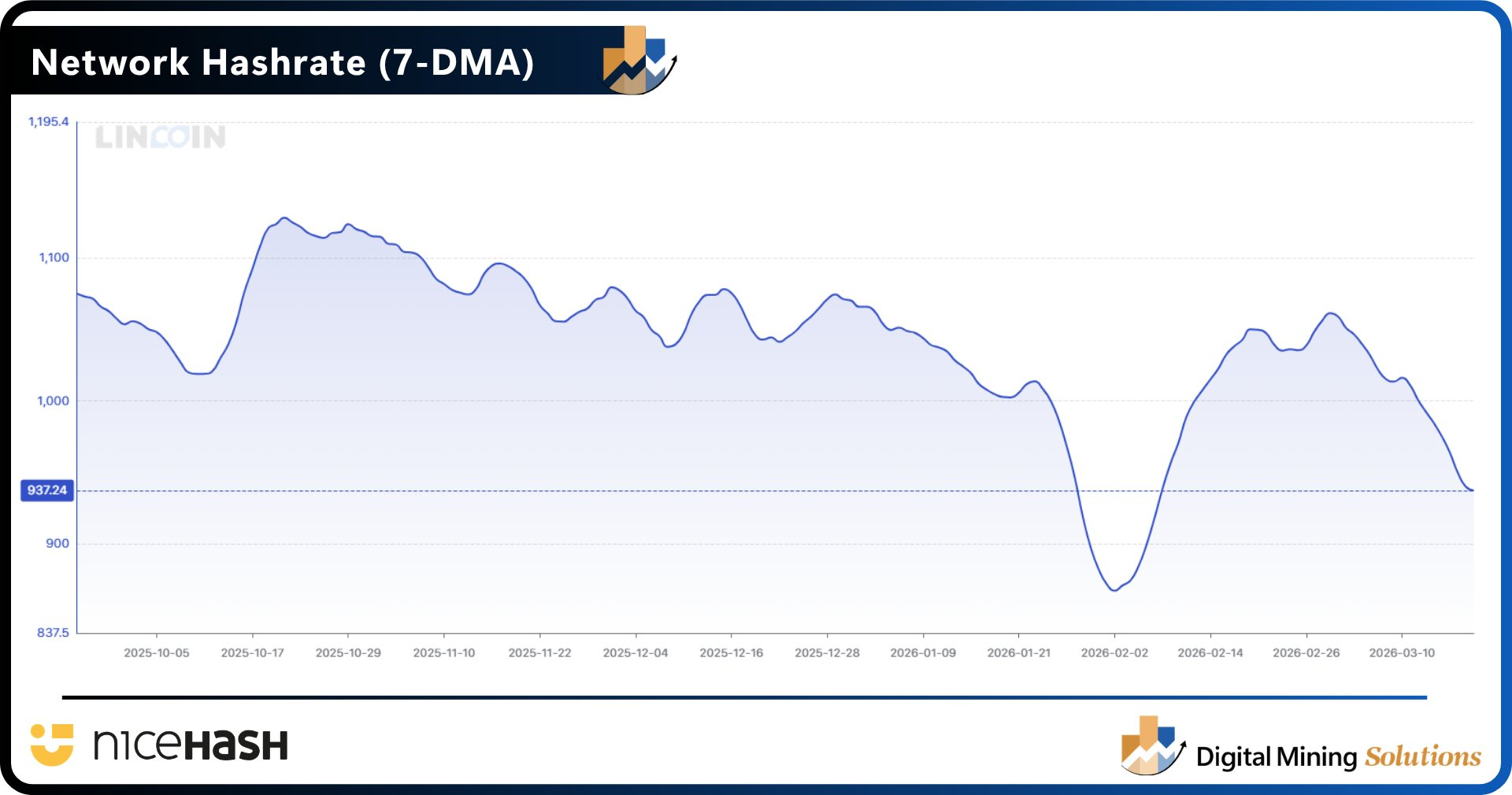
The recent downward difficulty adjustment and a slight 24-hour rebound in hashprice to $33.37 may provide brief relief to active operators. However, market forecasts indicate further margin compression lies ahead.
Mining difficulty is expected to slide an additional 0.52% to 133.10 trillion by the next adjustment period, setting the stage for a continued reshuffling of the global hashrate.
Notably, the network previously experienced a sharp drop in hashrate in early February. At the time, the decline was attributed to severe winter storms in the United States, which triggered temporary power curtailments.
However, industry analysts say this latest contraction is entirely different, representing a fundamental structural shift in the market.
Nico Smid, founder of Digital Mining Solution, noted that the current economic environment is forcing operators with older hardware and higher power costs to pull the plug entirely.
“This time, it looks like true economic capitulation. What we’re witnessing may not just be a temporary dip but a broader stress test across the mining sector. The miners who survive this phase will likely emerge leaner, more efficient, and structurally stronger,” Smid said.
Major publicly traded miners are facing compressed margins from Bitcoin’s recent price struggles and highly competitive network conditions. As a result, they are aggressively rethinking their capital allocation.
Industry heavyweights, including Core Scientific and Riot Platforms, are increasingly shifting their power reserves away from pure crypto mining and toward artificial intelligence ventures.
The strategic pivot reflects a stark economic reality for data center operators. While traditional Bitcoin mining yields fluctuating revenues tied to cyclical cryptocurrency markets, AI workloads can generate significant long-term revenue.
The post Bitcoin Mining Difficulty Plunges 8% as Squeezed Operators Pivot to AI appeared first on BeInCrypto.