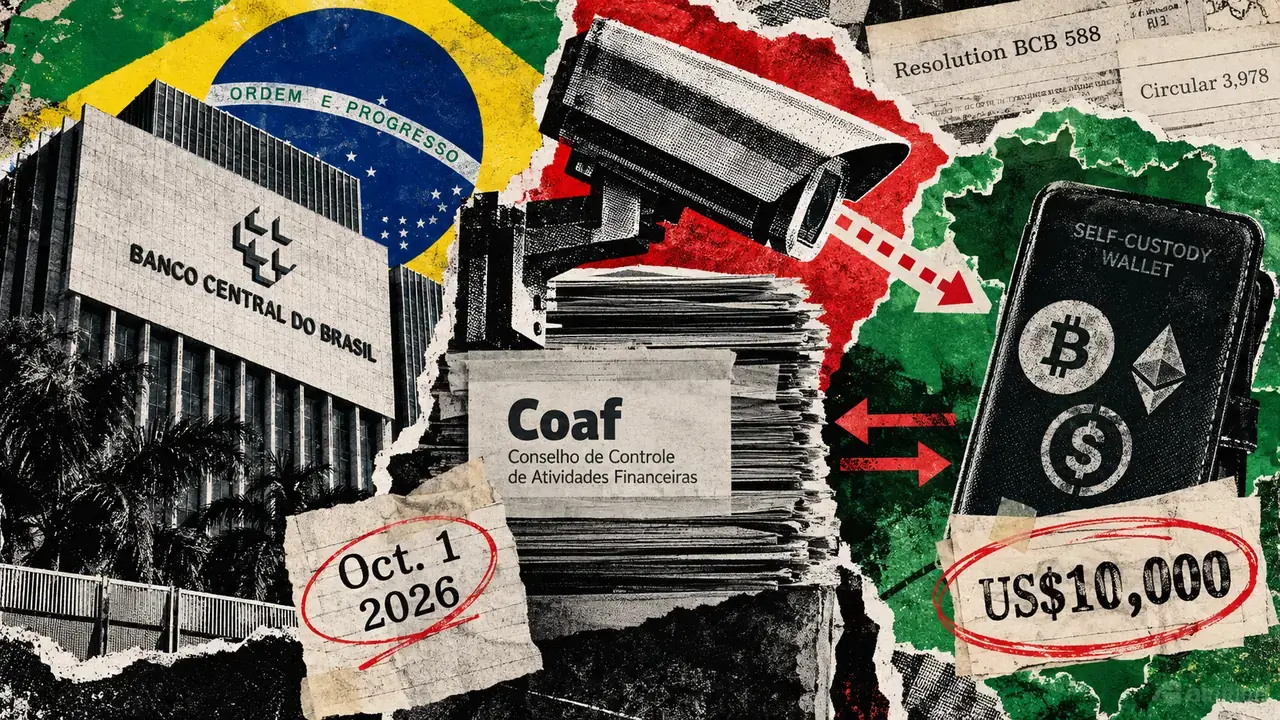
Brazil will require regulated financial institutions to report large crypto transfers involving self-custody wallets from Oct. 1.
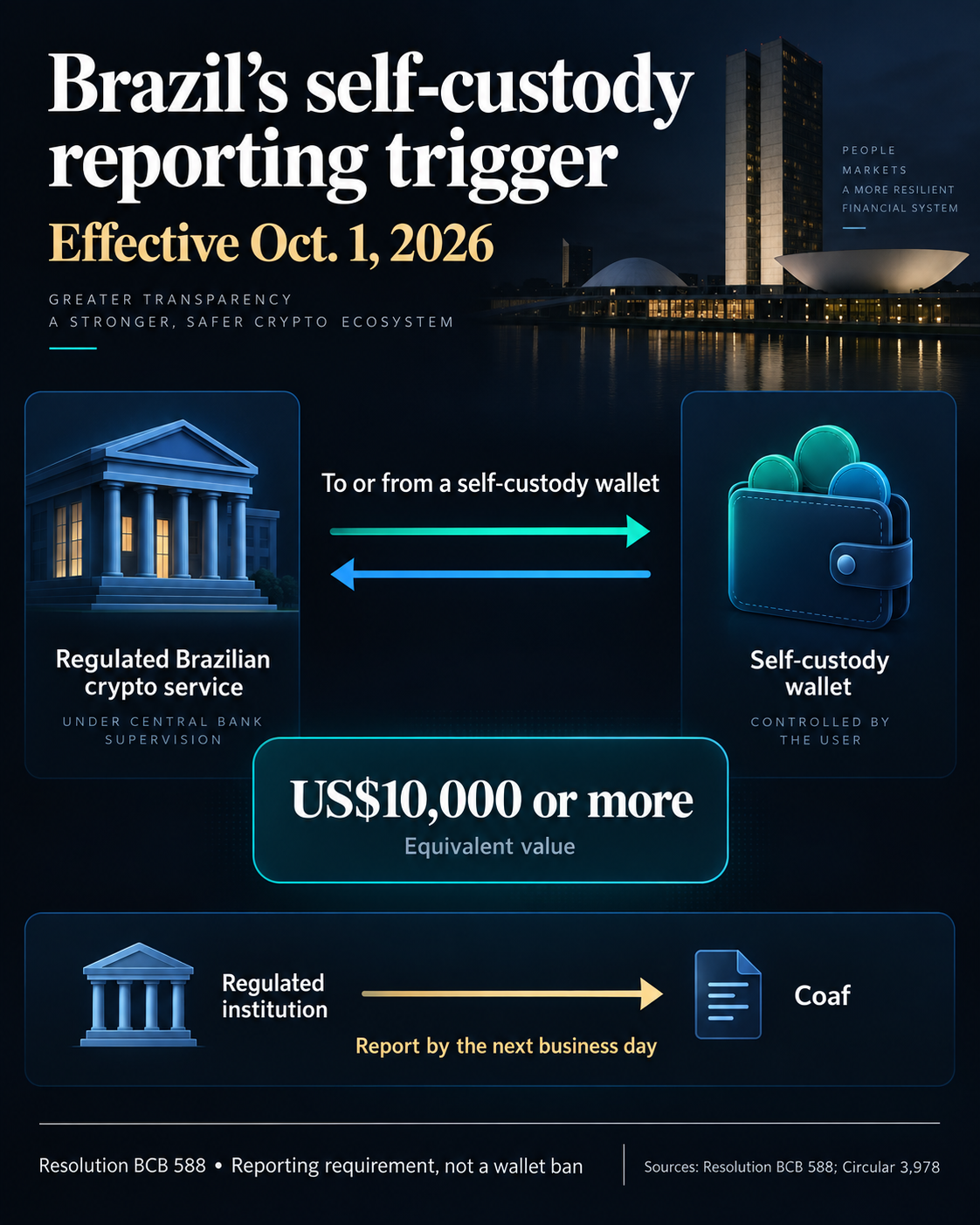
Under Resolution BCB 588, institutions authorized by the Banco Central do Brasil must notify the Financial Activities Control Council (Coaf) whenever they send virtual assets worth at least $10,000 to a self-custody wallet or receive the same amount from one.
The requirement covers both deposits from and withdrawals to wallets controlled directly by users. The filing obligation falls on the institution processing the transfer, with qualifying transactions reported to Coaf by the next business day under Brazil’s existing anti-money-laundering framework.
The threshold operates automatically. Institutions do not need to determine that a transaction is suspicious before filing a report, meaning legitimate transfers between an exchange and a customer's personal wallet can enter Coaf's reporting system solely because they meet the amount and transaction-type criteria.
Brazil already requires financial institutions to separately report transactions they assess as suspicious.
The new provision adds another layer by giving authorities visibility into large movements crossing the boundary between regulated platforms and self-custody, even where no suspicious activity has been identified.
The October measure also precedes tighter controls on some outbound crypto transfers.
Resolution BCB 584, scheduled to take effect Jan. 1, 2027, establishes a precautionary holding procedure for certain virtual-asset transfers leaving regulated institutions. Those transactions may be delayed while additional checks are conducted, although the framework allows earlier release where specified conditions are met.
Together, the measures increase scrutiny at the point where crypto enters or leaves Brazil's regulated financial system.
Exchanges, banks and other covered providers will need to identify self-custody counterparties, calculate transaction values and integrate automatic Coaf reporting into their monitoring systems before the October deadline. By January, some will also need processes that can hold outbound transfers for further review.
Rules land as Brazil's crypto market expands
The tougher oversight is being introduced in one of the world's largest crypto markets.
Brazil accounted for $252.5 billion of crypto activity during the period measured by Chainalysis, giving it the largest market in Latin America and helping it rank first in the firm's 2026 global crypto adoption index.
That ranking reflects broad participation rather than dominance in every category. Brazil placed third in flows through crypto services, fourth in on-chain balances, third in domestic peer-to-peer activity, and second in cross-border flows. The US ranked second overall.
The scale of those flows makes the self-custody threshold commercially significant. High-value users, trading firms, and businesses that regularly move assets between regulated platforms and private wallets are more likely to trigger automatic regulatory filings, while exchanges will bear the operational cost of identifying and reporting them.
Brazil's measured crypto economy nevertheless contracted 1.6% during the latest period, showing that the regulatory expansion is arriving even as near-term activity has cooled.
The post Brazil’s $252 billion crypto market gets $10,000 self-custody reporting rule appeared first on CryptoSlate.