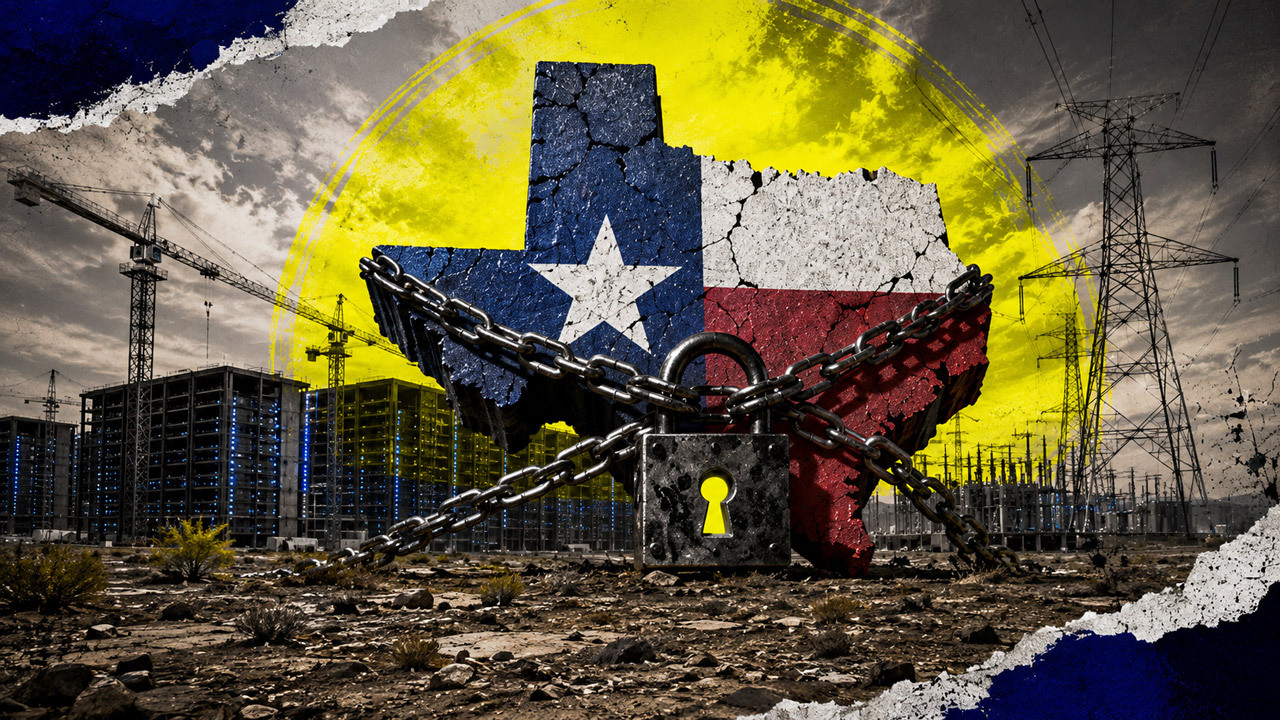
Texas Gov. Greg Abbott ordered the Public Utility Commission and ERCOT to audit every data center project seeking a grid connection before regulators approve any new projects. The order puts AI infrastructure tied to Bitcoin miners under scrutiny, while the audit verifies each project's power sourcing, water use, cooling plans, and ownership.
The order covers roughly 474 GW of pending connection requests, and Abbott said about 90% of that demand comes from data centers.
That figure runs more than five times the grid's record peak load. ERCOT paused its Batch Zero transmission-planning study once the order landed, and a separate PUCT survey shows that only 28 of 377 companies responded when asked about their data center plans.
Public Bitcoin miners have spent the past year pitching investors on multi-gigawatt AI infrastructure pipelines.
Those numbers can bundle very different assets under one label, such as raw land near a substation, a queue position still waiting on interconnection studies, and a financed campus already under construction.
Texas just forced a test of that distinction, and FERC is building a matching one at the national level.
| Pipeline label | What it may actually mean | Risk level | Investor takeaway |
|---|---|---|---|
| Raw land | Site near power infrastructure | High | Optionality, not capacity |
| Queue position | Project waiting for interconnection review | High | Exposed to audits, delays and denial |
| Utility study | Power access is being evaluated | Medium-high | More advanced, but not guaranteed |
| Approved interconnection | Grid path is clearer | Medium | Valuable, but still needs buildout |
| Energized substation | Power can physically flow | Lower | Major de-risking milestone |
| Signed tenant | Customer demand is contracted | Lower | Revenue visibility improves |
| Project financing | Capital stack is secured | Lower | Construction becomes the main risk |
| Operating campus | Load is live and revenue-producing | Lowest | Highest-quality capacity |
Why Hut 8 is further up the AI infrastructure ladder
Hut 8's second-quarter numbers show that the company has raised $7.5 billion in project-level financing across two flagship sites, River Bend and Beacon Point, backing 949 MW of contracted IT capacity worth roughly $26.6 billion in expected base-term contract value.
River Bend sits in Louisiana, outside the Texas order entirely. Beacon Point sits in Texas, fully commercialized across roughly 1 GW, and is financed with $4.25 billion in secured notes. It also comes with signed tenants, dedicated financing and construction already underway, a level of de-risking most queue-stage developers cannot match.
Alongside Hut 8's financed sites, the company reports a roughly 8.66 GW pipeline that still includes capacity under diligence and exclusivity — the less mature rungs of the same ladder.
IREN energized its 1.4 GW Sweetwater 1 site in May, and its existing Childress capacity already backs signed contracts with Microsoft and Nvidia. The company's filings still warn that ERCOT's batch review could affect the timing of Sweetwater's next phase.
About 700 MW of HPC capacity is under Cipher Digital‘s contract, while roughly 2 GW of its Texas pipeline, including the McLennan, Colchis and Mikeska sites, remains subject to that batch process.
MARA's operating fleet and behind-the-meter power strategy give it a base outside any single approval path. Its proposed 2 GW Matagorda project relies on a different structure, with milestone payments tied to regulatory approval, power authorization and a signed tenant lease.
CleanSpark has a contracted project in Georgia entirely outside ERCOT's reach. Its Texas sites, 285 MW near Houston and up to 600 MW near Brazoria County, still depend on approvals and power availability that have not yet been secured.
Riot Platforms holds a 700 MW interconnection at Rockdale and an AMD lease that starts at 25 MW, with room to expand toward 200 MW. Its larger Corsicana plan, roughly 600 MW, is still at an earlier stage.
Core Scientific operates about 300 MW of mining capacity at its Pecos campus today, while its plan to expand that site to 1.5 GW rests on power and leases that don't yet exist.
| Company | More de-risked assets | Assets still exposed to approvals or execution |
|---|---|---|
| Hut 8 | River Bend and Beacon Point: contracted, financed and under construction | 8.66 GW pipeline includes earlier-stage diligence and exclusivity |
| IREN | Sweetwater 1 energized; Childress backs Microsoft and Nvidia contracts | Later Sweetwater expansion exposed to ERCOT timing |
| Cipher Digital | Around 700 MW of contracted HPC capacity | McLennan, Colchis and Mikeska remain subject to ERCOT batch process |
| MARA | Operating fleet and behind-the-meter strategy | Matagorda depends on approvals, power authorization and tenant lease |
| CleanSpark | Contracted Georgia project outside ERCOT | Texas sites still depend on approvals, construction and power availability |
| Riot Platforms | Rockdale interconnection and AMD lease | Larger Corsicana AI plan remains earlier-stage |
| Core Scientific | 300 MW operating mining footprint at Pecos | Expansion toward 1.5 GW depends on future power and leases |
Why this reaches past Texas
FERC extended the same logic nationally on June 18, ordering six regional grid operators—PJM, MISO, SPP, CAISO, ISO New England and NYISO—to justify or rewrite their rules for large-load customers like data centers.
Those operators have 60 days to respond to their large-load tariffs and 30 days to explain how they will secure sufficient generation to meet new demand.
That reach already touches miner-built infrastructure outside Texas. Hut 8's River Bend sits in MISO, MARA's Long Ridge project sits in PJM, TeraWulf runs major AI capacity in NYISO, and its Abernathy, Texas site connects through SPP's grid, a separate interconnection queue entirely. Bitdeer is building a 570 MW site in Ohio, also inside PJM.
The urgency stems from demand growth outpacing grid planning. Goldman Sachs recently forecast US data-center power demand climbing from 31 GW in 2025 to 41 GW in 2026 and 66 GW in 2027.
The Energy Information Administration has raised the same point, noting that US electricity demand grew by about 1.7% per year from 2020 to 2025, compared with 0.1% per year in the 15 years before that.
For investors, the practical effect is an AI infrastructure repricing test. A gigawatt tied to signed tenants, secured financing, and an energized substation is worth more than a gigawatt that exists as land and a queue number. The market has mostly priced them the same.
Which way the repricing breaks
The bull case is that capital flows toward operators that can prove the whole chain behind their AI infrastructure — power, tenants, financing and construction — as Hut 8, IREN and Riot already can on their most advanced sites.
Regulators also reward flexible, behind-the-meter load. FERC's order explicitly asks grid operators to address co-location and behind-the-meter generation, the capabilities Bitcoin miners have developed over years of curtailing load and trading power around volatile grid conditions.
Developers who cannot clear the audit become targets. Well-capitalized miners could pick up land with advanced grid studies, existing interconnection rights and half-built campuses at a discount. That turns stalled projects into leased AI capacity.
The bear case is that audits and FERC's reviews stall a large share of queue-dependent capacity for longer than developers can fund it. Cipher Digital's, CleanSpark's, and MARA's less mature sites carry that risk directly.
Any miner whose AI infrastructure valuation still leans on gigawatts without signed tenants or secured financing faces a harder repricing. Stocks built on advertised pipeline size re-rate toward whatever portion of that pipeline is energized, contracted, and financed.
Hyperscalers with deeper balance sheets absorb the demand that stalled miner projects cannot deliver.
| Scenario | What regulators do | What happens to miners | Who benefits |
|---|---|---|---|
| Bull case | Audits separate real projects from speculative queues | Capital flows to miners with power, tenants, financing and construction | Hut 8-like financed campuses, energized sites, named-tenant projects |
| M&A case | Weaker developers cannot clear the next milestone | Better-capitalized miners buy land, interconnection rights or half-built campuses | Operators with capital and hyperscaler relationships |
| Bear case | Reviews stall queue-dependent capacity | Pipeline-heavy miners re-rate lower | Hyperscalers and traditional data-center operators |
| Power premium case | Behind-the-meter and flexible loads get regulatory preference | Miners with curtailment and power-trading experience gain leverage | Operators with flexible-load expertise |
| Grid backlash case | Cost, water and reliability politics intensify | More projects face delays, denials or higher upgrade costs | Already energized and contracted campuses |
An investor can be right about Bitcoin and still misjudge a miner whose AI valuation depends on power that never arrives. Texas and FERC made that gap the thing worth pricing.
The gigawatt on the slide is worth less than the megawatt that is energized, contracted, and financed.
The post Bitcoin miners’ AI pipelines are on trial as Texas freezes 474 GW of data center requests appeared first on CryptoSlate.