

Bitcoin's return to positive exchange-traded fund flows is colliding with a deeper contraction in crypto-market liquidity, leaving its recovery vulnerable as oil prices climb and geopolitical tensions disrupt one of the world’s most important energy corridors.
Data from CryptoSlate shows that the recent inflows have helped Bitcoin stabilize near $64,000 after an eight-week investor retreat.
Yet stablecoin reserves continue to fall on major exchanges, limiting the capital available to sustain a breakout above the resistance that has capped the cryptocurrency for months.
That divide has left Bitcoin caught between improving sentiment and a market structure that could expose leveraged traders to a sharper decline if support near $60,000 gives way.
Oil above $90 threatens Bitcoin’s inflation relief
The macroeconomic conditions that helped Bitcoin recover are coming under renewed pressure as fighting between the United States and Iran disrupts shipping through the Strait of Hormuz.
Brent crude climbed to a one-month high above $91 a barrel as markets priced in the risk of prolonged interruptions to global energy supplies. The advance threatens to revive inflation concerns shortly after softer US price data eased fears that monetary policy would remain restrictive for longer.
On July 20, US Central Command said American forces completed their ninth consecutive evening of strikes against Iran at 10 p.m. Eastern time.
The operation targeted Iranian military command centers, air-defense and coastal-surveillance sites, maritime capabilities, communications networks and missile and drone launch positions, CENTCOM said.
The military described the strikes as part of an effort to reduce Iran’s ability to attack commercial vessels and civilian mariners traveling through the Strait of Hormuz.
The economic fallout of these actions is already becoming visible in shipping data.
No liquefied natural gas tanker had crossed the strait since Thursday, while broader vessel traffic fell sharply over the weekend, data cited by Reuters showed. Only four vessels transited the waterway Sunday, down from eight the previous day, as tankers accumulated in the Gulf while waiting for conditions to improve.
The disruption creates a new complication for Bitcoin and other assets sensitive to global liquidity.
Recent US inflation reports had encouraged expectations that the Federal Reserve might have more room to loosen monetary policy or avoid further tightening. Lower rates and declining bond yields generally reduce the appeal of holding cash and fixed-income securities while supporting demand for risk assets.
Oil could spoil that relief. If energy prices stay high, transport costs may seep back into inflation and keep financial conditions tight, giving Bitcoin less room to run.
Simon-Peter Massabni, head of business development at XS.com, told CryptoSlate that the market is now facing opposing macroeconomic forces.
Softer inflation has reduced concerns about an extended period of restrictive policy, he said, but the surge in oil prices could quickly reverse those expectations if it begins feeding into consumer prices and broader inflation measures.
Bitcoin’s recovery is therefore relying partly on a disinflation narrative that the conflict around the Strait of Hormuz now threatens to disrupt.
ETF inflows return without a broad recovery in demand
Against that worsening macroeconomic backdrop, US-listed spot Bitcoin ETFs have recorded two consecutive weeks of inflows, though the scale and distribution of the capital suggest demand remains narrow.
The funds attracted $75.67 million during the week of July 13 through July 17, following a stronger $197.40 million intake in the previous trading week, SoSoValue data showed.
The combined $273 million marked a reversal after eight consecutive weeks of withdrawals in which investors pulled more than $8 billion from the products.
The improvement has helped Bitcoin stabilize between $64,000 and $65,000, but it has recovered only a small fraction of the capital that left during the preceding selloff. The two weeks of inflows replaced roughly 3% of the money withdrawn during the eight-week losing streak.
Meanwhile, the current ETF rebound has also depended heavily on BlackRock’s iShares Bitcoin Trust.
IBIT attracted about $204 million during the latest week, exceeding the net inflow recorded by the entire US spot Bitcoin ETF market. Gains in BlackRock’s fund and Grayscale’s smaller Bitcoin Mini Trust were offset by withdrawals from competing products, including Fidelity’s Wise Origin Bitcoin Fund.
That concentration makes the positive flow streak less convincing than the headline total suggests.
Massabni said the four consecutive sessions of inflows during the latest week showed that selling pressure was easing.
However, the dominance of a single fund suggests that demand has not yet spread across the broader ETF market.
A $2.3 billion stablecoin exodus deprives the market of critical dry powder
The limited ETF rebound has coincided with a deeper contraction in stablecoin reserves on major cryptocurrency exchanges.
Binance recorded about $1.55 billion in stablecoin withdrawals over the past 30 days, while reserves on Bybit declined by another $786 million during the same period, an analysis of CryptoQuant data showed.
The combined reduction of nearly $2.3 billion leaves less stablecoin capital sitting on the two platforms and immediately available to purchase Bitcoin or other digital assets.
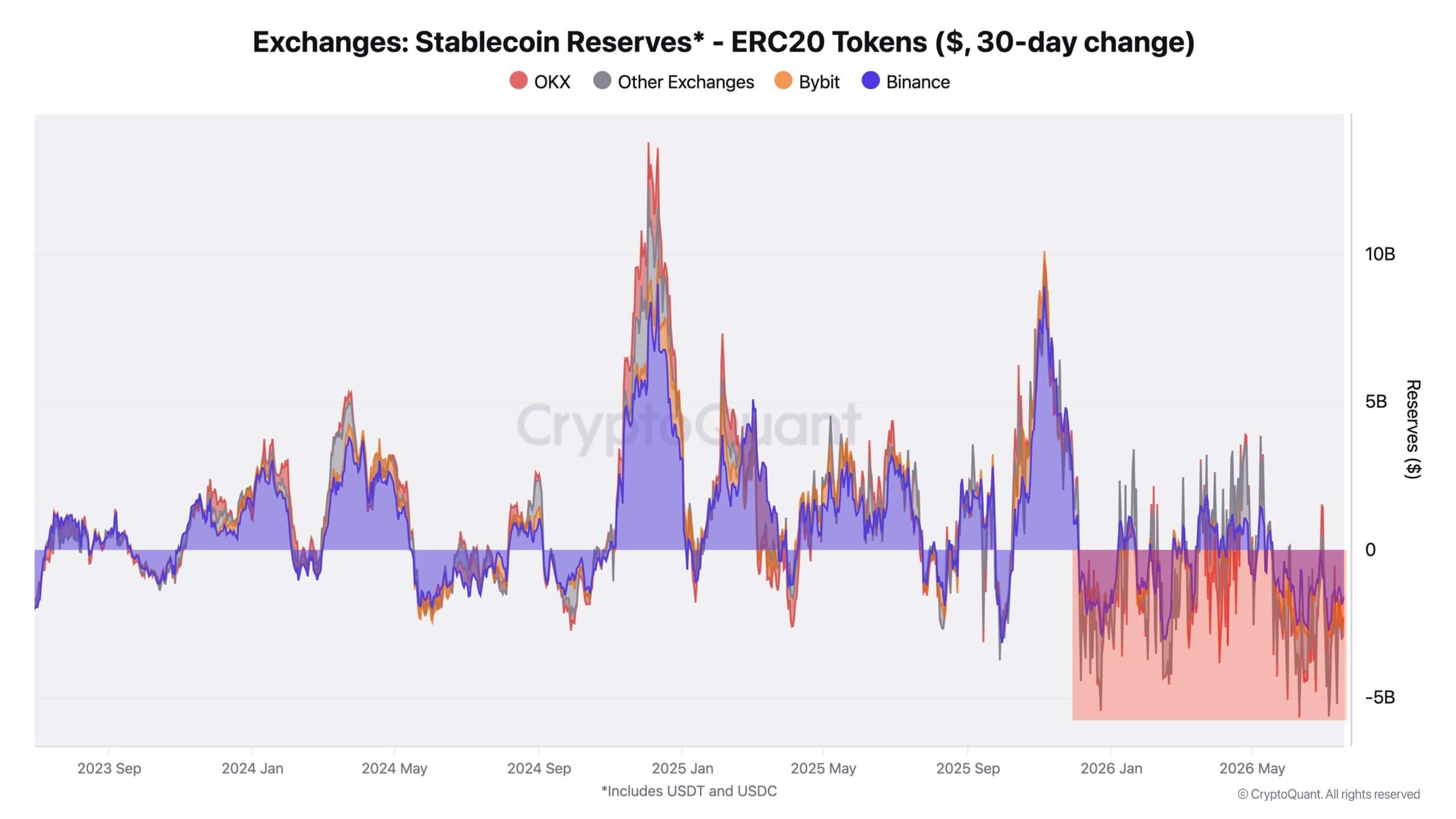
Stablecoins serve as a central source of liquidity across crypto markets. Traders frequently hold tokens such as USDT and USDC on exchanges, allowing them to move into Bitcoin and other cryptocurrencies without first transferring money through the traditional banking system.
A sustained decline in those reserves can weaken the market’s ability to absorb sales or support an extended rally.
Hence, this current contraction helps explain why Bitcoin has continued to struggle against the $60,000 to $65,000 range.
CryptoQuant analyst Darkfost pointed out that the cryptocurrency has spent nearly 165 days repeatedly testing the lower portion of that zone. Buyers have prevented a deeper decline, but those defenses have not produced enough follow-through demand to sustain a breakout.
Derivatives positioning exposes longs to a potential $57,000 flush
This lack of spot liquidity leaves the market highly vulnerable to the structural mechanics of the derivatives sector.
Data provided by analytics platform Alphractal highlights a dangerous concentration of leveraged positioning that could dictate the asset's next major directional move.
Analyzing six-month liquidation metrics, Alphractal identified that the primary liquidity pools for short sellers reside distantly between $82,000 and $84,000. Conversely, long positions are densely clustered near the current spot price, specifically between $55,000 and $57,000.
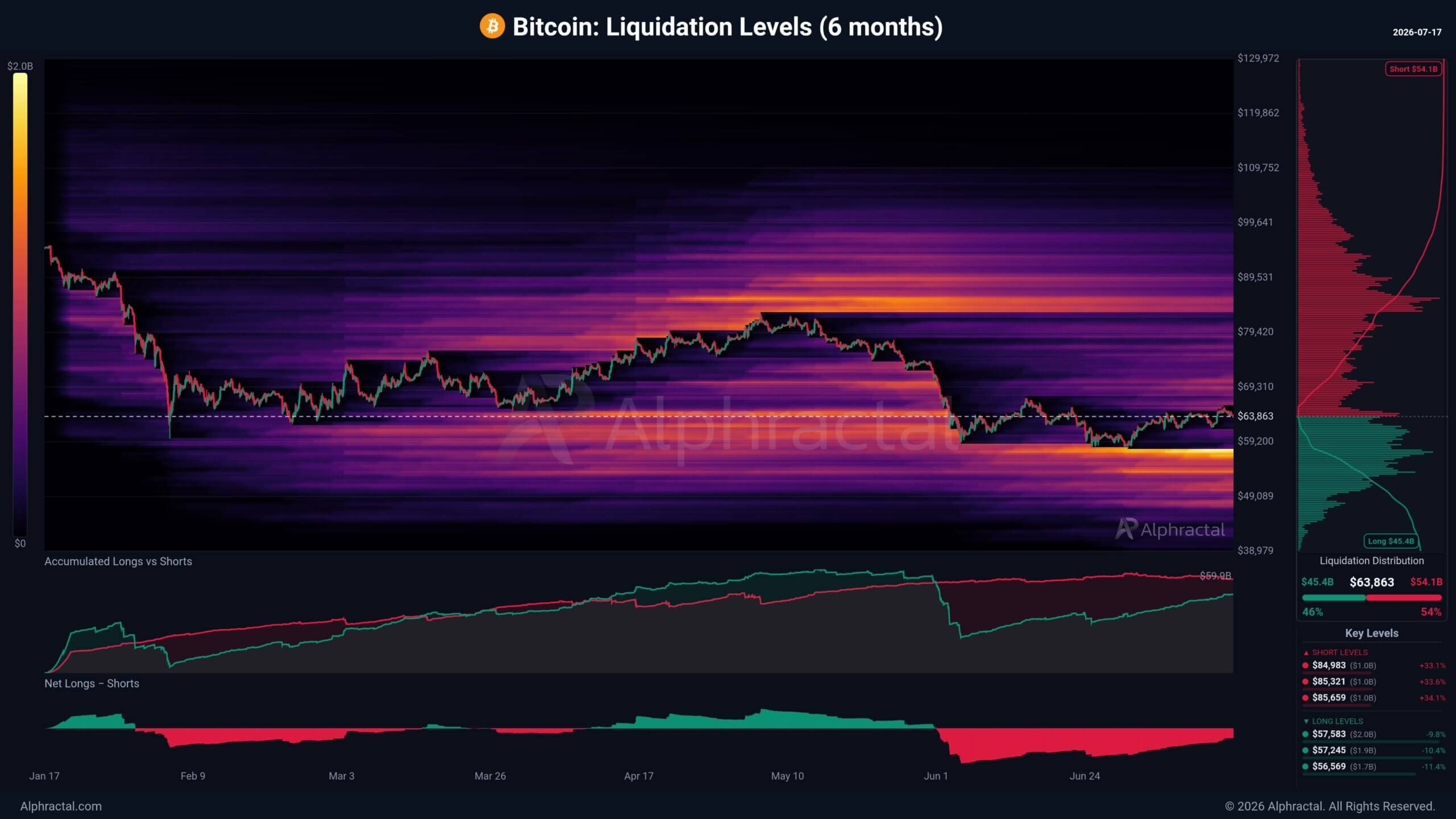
The massive concentration of leveraged longs directly at the $57,000 mark creates a gravitational pull for the market; should macroeconomic pressures or ETF outflows push Bitcoin below its current support, it could trigger a catastrophic wave of forced liquidations across multiple exchanges.
Despite these looming risks, some market analysts maintain a tentatively constructive outlook based on sentiment indicators.
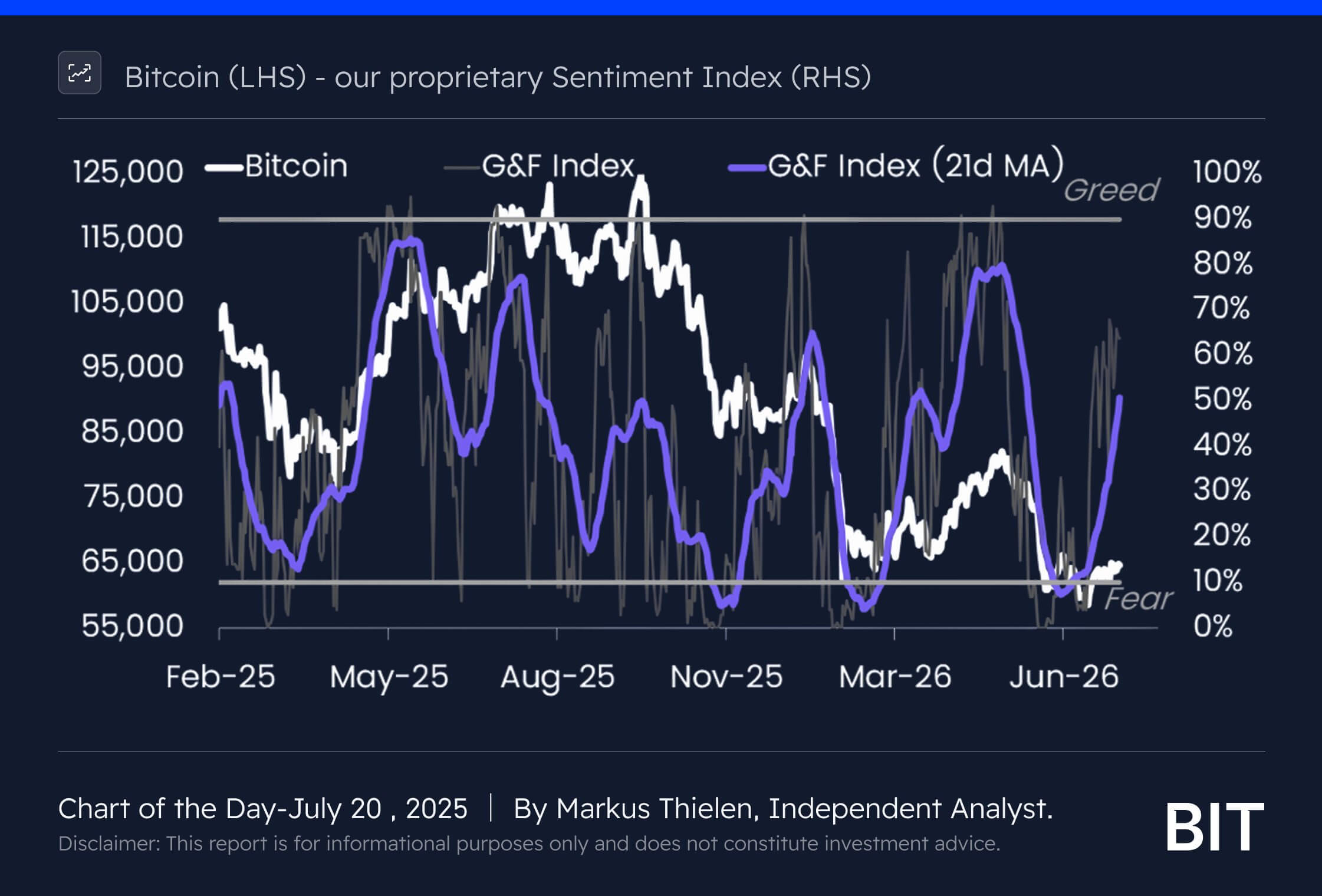
BIT Official reported that its proprietary Greed & Fear Index is showing signs of improvement despite the overarching bearish positioning.
The firm noted that historically, when the 21-day moving average of this index turns upward, it has marked major tactical bottoms for Bitcoin, suggesting the $60,000 to $65,000 zone may hold as resilient support.
Similarly, independent Bitcoin analyst Michael Van de Poppe noted that the current period of historically low volatility is a necessary phase for establishing fundamental support.
He indicated that breaking and holding the $65,000 resistance level is the critical prerequisite for a broader market rally, while a failure to hold $61,000 would inevitably lead to a test of the $50,000 range.
Ultimately, the market's trajectory hinges on the persistence of external capital.
As BRN Research outlined in an emailed statement to CryptoSlate, the ecosystem simply cannot afford a return to negative institutional flows.
According to the firm, the $62,000 to $65,000 supply band now serves as the ultimate proving ground, and it will either act as the launchpad for a structural reversal or the ceiling that forces the market down to reckon with the $57,000 liquidation pool.
The post Bitcoin ETF inflows return, but $2.3 billion stablecoin liquidity drain leaves $57,000 exposed appeared first on CryptoSlate.