
Jack Mallers says he left Twenty One Capital voluntarily and with “no severance” despite collecting roughly $1.6 million in cash on the way out and over $2.2 million in total compensation. He also claims he forfeited his options.
In a statement issued hours after stepping down as CEO of the Tether-controlled BTC treasury company, Mallers claimed to have left “voluntarily” and mentioned his lack of severance and options as though that summarized the situation.
However, omitted from his post was his lavish, seven-figure separation agreement and the millions of dollars he made personally while common shareholders’ investment halved — at best — under his tenure.
Below are details about Mallers’ failure to accomplish a variety of business goals at Twenty One. However, we must first address his staggering compensation and its conspicuous omission from his social media.
Jack Mallers made over $2.2 million from Twenty One
As part of his separation package, Twenty One awarded Mallers a final $50,000 salary payment, which is apparently so “small” it doesn’t qualify as severance.
Twenty One is also paying him $420,455 for his “vested restricted shares,” plus an incredible $1,151,046 in cash to repurchase 226,860 of his shares at $5.23 apiece.
That’s more than $1.6 million in cash for Mallers to resign “voluntarily,” paid to a man who claims he took no severance and forfeited his options.
The company is also paying him out for shares above the current market, which is trading for less than $5 today.
The document never uses the word “severance,” which is presumably how Mallers can claim that he didn’t take any — the most incredible technicality.
Despite his seven-figure payday that was nowhere to be found on his social media, he did forfeit some extras.
The company cancelled his unvested options and restricted stock for nothing, and he kept 1,522,407 vested options with a $14.43 strike price, which are currently out-of-the-money due to Twenty One shares trading below $5.
Those options are the part he can safely call worthless. Of course, they were already out-of-the-money before he “forfeited” them.
Read more: The more Jack Mallers says Twenty One is ‘different,’ the more its stock falls
Profit never arrived
Twenty One went public in 2025 through a reverse merger with Cantor Equity Partners, a Cantor Fitzgerald blank-check vehicle tied to the sons of US Commerce Secretary Howard Lutnick.
Tether and Bitfinex supplied the BTC and the voting control while Mallers supplied a face for TV.
For his celebrity status and “leadership,” they paid him handsomely.
His 2025 compensation package exceeded $667,898 plus a massive 12 million share options award that mostly expired worthless as Twenty One fell below Mallers’ $14.43 strike price.
Still, he banked $667,898 — $236,250 in bonus and $431,648 in consulting fees — routed through a Twenty One entity in 2025. Twenty One even paid $165,000 to cover the legal bill for negotiating his own contract.
Mallers said Twenty One would succeed at a variety of businesses, and it failed or never started almost all of them.
In countless interviews in 2025, he mentioned a variety of business aspirations that remained aspirational.
Today, when someone asked what he had actually accomplished at Twenty One, Mallers could only list raising money, going public, and having a large valuation. No profitable business operation made his summary.
Mallers fell short of Coinbase goal
At the Bitcoin 2026 conference in April 2026, Mallers pitched Twenty One as a company that would generate cash flow and run profitable operations.
He said he wanted Twenty One “to get to the point where we are doing the same amount of revenue, with the same amount of customers and the same amount of operating profits as Coinbase.”
He repeatedly refused to characterize Twenty One as a passive, BTC-holding treasury company.
Unfortunately, Mallers was terrible at forecasting. Twenty One reported no such cash flow and launched no such profitable operations. In fact, it remained exactly what Mallers swore it wouldn’t: a BTC treasury stock with minimal net income.
Protos has documented how Mallers quietly dropped Twenty One’s BTC-per-share metric he once told shareholders to judge him by. The problem that solved was simple: BTC per share didn’t increase over time.
Mallers returns to Strike to help Twenty One
Profits were supposed to arrive via a three-way combination of Twenty One, Mallers’ payments app Strike, and BTC miner Elektron.
On July 21, the company confirmed that Strike “plans to remain a standalone business and is no longer being considered for a business combination with Twenty One.”
The deal meant to manufacture operating income collapsed before terms finalized.
Because that merger collapsed, Mallers never actually sold his Strike equity to Twenty One. Whatever paper value the private company carries, he’s realized none of it here.
The board handed the company back to a Tether-friendly executive, Raphael Zagury, who runs Elektron and had sat on Twenty One’s board since December.
It also reframed its new strategy around “Cash Flow Generation,” an implicit admission that significant cash flow never showed up under Mallers’ leadership.
The 8-K states Mallers’ departure was “not related to any disagreements” with the company.
Despite claiming Twenty One would grow to “the same amount of customers and the same amount of operating profits as Coinbase,” Mallers walked out roughly a year later with none of that accomplished, over $2.2 million in cash compensation, and a broken pitch.
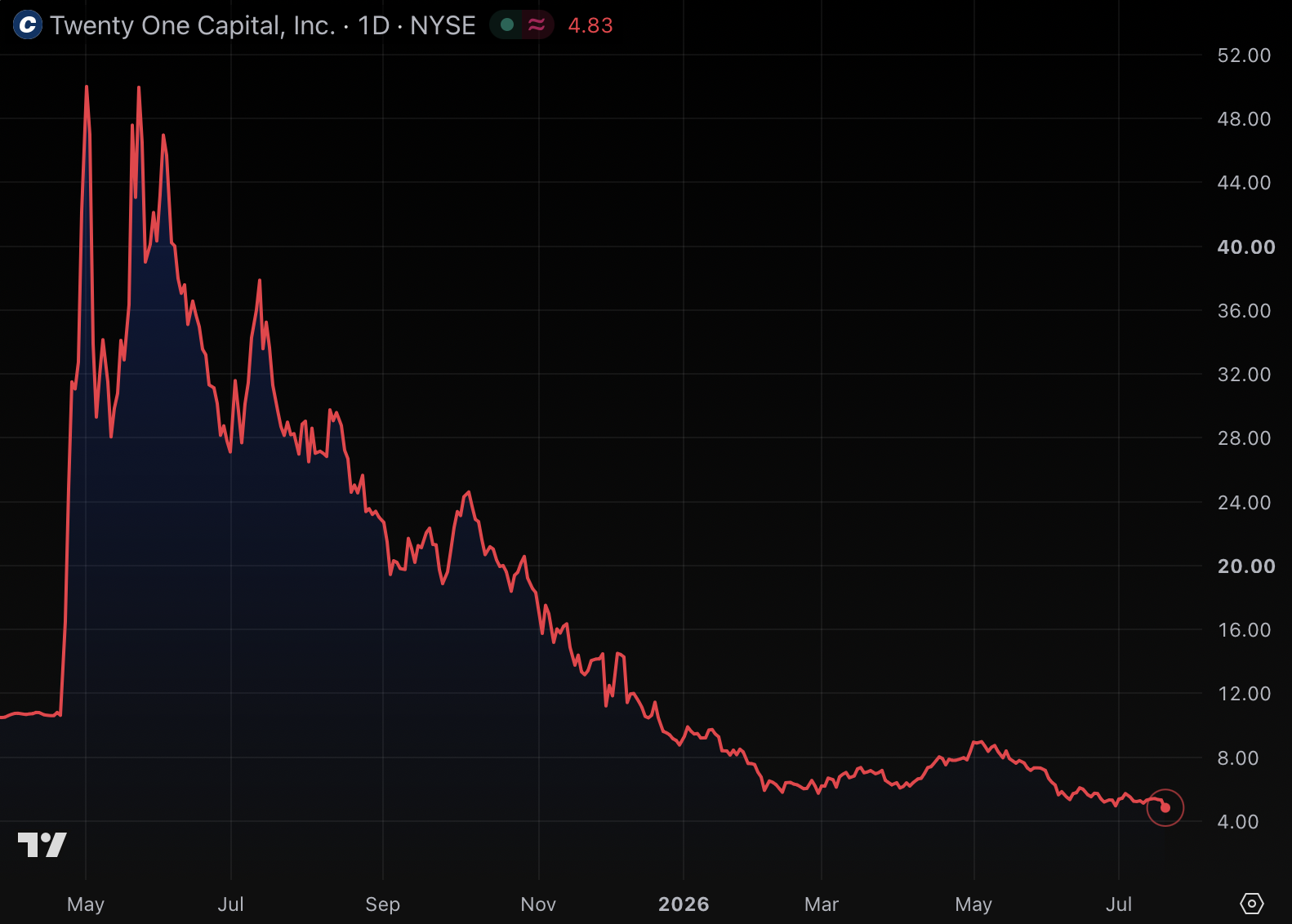
As of writing time, Twenty One was trading 84% below its 52-week high and 91% below its 2025 high.
Worse, the price of Twenty One is two-thirds lower today than its $17.83 high the day Mallers joined the company.
Got a tip? Send us an email securely via Protos Leaks. For more informed news and investigations, follow us on X, Bluesky, and Google News, or subscribe to our YouTube channel.
The post Jack Mallers leaves Twenty One after overseeing 91% decline appeared first on Protos.