
Strategy's latest Bitcoin sale lifted its 2026 disposals to 5,258 BTC, the largest amount it has sold in any year since adopting the asset in 2020, as the company redirects capital toward supporting its preferred securities.
The company sold 1,638 BTC for $104.7 million between July 27 and Aug. 2 and issued about 3.01 million MSTR common shares for another $290.6 million, according to an Aug. 3 filing with the US Securities and Exchange Commission.
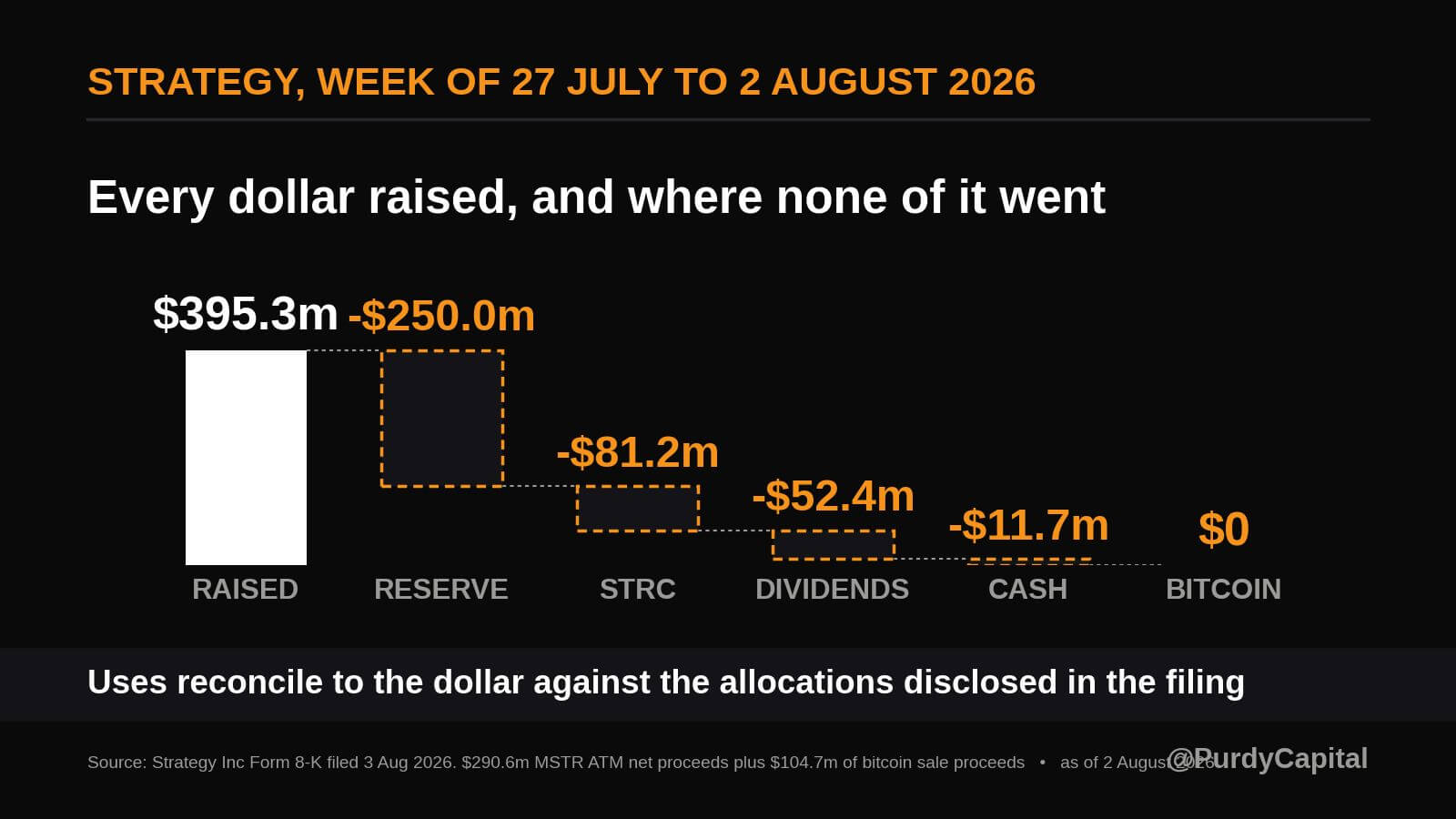
None of the nearly $395 million raised went toward new Bitcoin purchases. Instead, Strategy used the capital to fund preferred dividends, repurchase STRC shares and complete the expansion of its US dollar reserve to $4 billion.
The allocation extended its Bitcoin acquisition pause to six consecutive weeks, its longest since 2024.
STRC's discount forces Strategy to redirect capital
The most immediate obstacle to Strategy resuming Bitcoin purchases is STRC, a variable-rate preferred stock the company wants to establish as a repeatable funding source for its treasury.
When STRC trades near its $100 stated amount, Strategy can issue additional shares around par and deploy the proceeds across its capital structure, including toward Bitcoin purchases.
Trading at a sustained discount weakens that channel because new issuance would require either a lower sale price or a higher dividend yield to attract investors.
STRC has remained below par since May despite a dividend structure that allows Strategy to adjust the payout to support its market price. The company has responded by raising the annual dividend rate to 12% and repurchasing shares at a discount.
Last week, Strategy used $52.3 million from its Bitcoin sale and $28.9 million from its MSTR issuance to buy back 912,143 STRC shares for $81.2 million.
The transaction followed a $25 million repurchase the previous week, when the company acquired 288,930 shares at an average price of $86.53.
During the company's second-quarter earnings call, Strategy President and CEO Phong Le said buying STRC below par allows the company to retire future dividend obligations at a discount while strengthening demand as the shares move toward $100.
Strategy has now spent about $106.2 million on STRC repurchases since launching the program in July. It retains $893.8 million under its preferred-stock repurchase authorization, while a separate $1 billion authorization for MSTR common-share buybacks remains unused.
The company is targeting a return to par for STRC by September, with the pace of further purchases dependent on the stock's price and market liquidity.
Reaching that target would restore a financing channel that has become increasingly important to Strategy. The company raised $7.53 billion through its capital programs in 2026 through July 26 as preferred securities assumed a larger role in funding its balance sheet.
A $4 billion reserve protects preferred payments
Strategy also used last week's common-stock issuance to complete a rapid expansion of the cash reserve supporting its preferred dividends and debt interest.
Of the $290.6 million raised through MSTR sales, $250 million was transferred to the US dollar reserve, and $11.7 million was retained as cash.
The company had already increased the reserve from $2.55 billion at the end of June to $3.75 billion by July 26, primarily through common-stock issuance. The latest allocation lifted it to the $4 billion target.
Strategy estimated its annual preferred-dividend and debt-interest obligations at about $1.76 billion when it introduced its revised capital framework in June. At that rate, the reserve would cover approximately 27 months of payments.
Without further board approval, the funds can be used only to pay preferred dividends and interest on outstanding debt.
The reserve reduces the risk that Strategy would need to issue securities or sell Bitcoin under unfavorable market conditions merely to meet near-term obligations. It also provides preferred investors with a dedicated source of cash even when Bitcoin prices fall or access to capital markets deteriorates.
That protection, however, was largely financed through common-stock dilution.
Strategy issued about 3.01 million MSTR shares last week without purchasing additional Bitcoin. At the same time, its treasury declined by 1,638 BTC, reducing the amount of Bitcoin represented by each assumed diluted common share.
Longtime Bitcoin critic Peter Schiff said the transactions showed Strategy increasingly using Bitcoin sales and MSTR issuance to protect preferred investors.
The effect was visible in the company's Bitcoin-per-share performance measures. Strategy's year-to-date BTC Yield fell to 3.5%, compared with 13.3% in late May. Its quarter-to-date BTC Yield stood at -4.6%, while its BTC Gain declined by nearly 40,000 BTC, equivalent to about $2.4 billion at current prices.
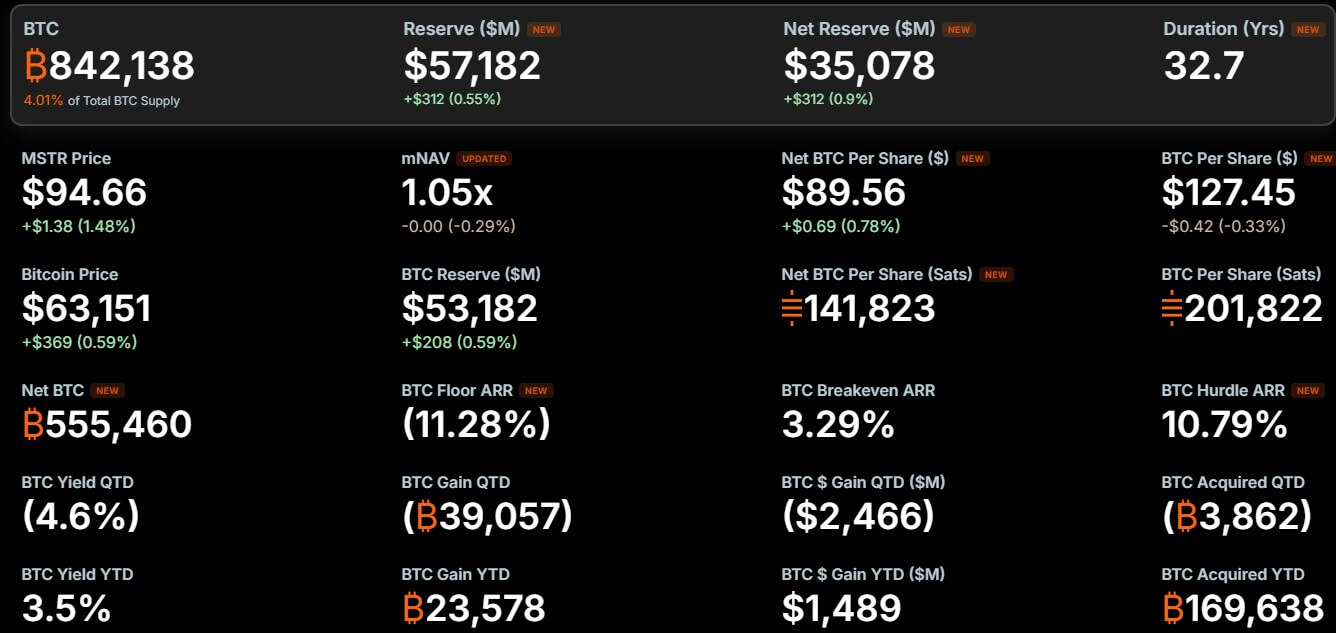
Strategy defines BTC Yield as the percentage change in Bitcoin held per assumed diluted share. BTC Gain converts that percentage change into an estimated number of Bitcoin.
The company cautions that neither measure represents shareholder returns, income, cash flow, or its ability to meet financial obligations.
The reserve therefore strengthens Strategy's ability to meet preferred and debt payments, but it shifts more of the financing burden onto MSTR shareholders whose exposure depends on Bitcoin accumulation outpacing dilution.
Bitcoin becomes an active source of liquidity
Strategy's aggressive Bitcoin selling this year shows that the asset is now being used as an operational source of liquidity for the securities business built around its treasury.
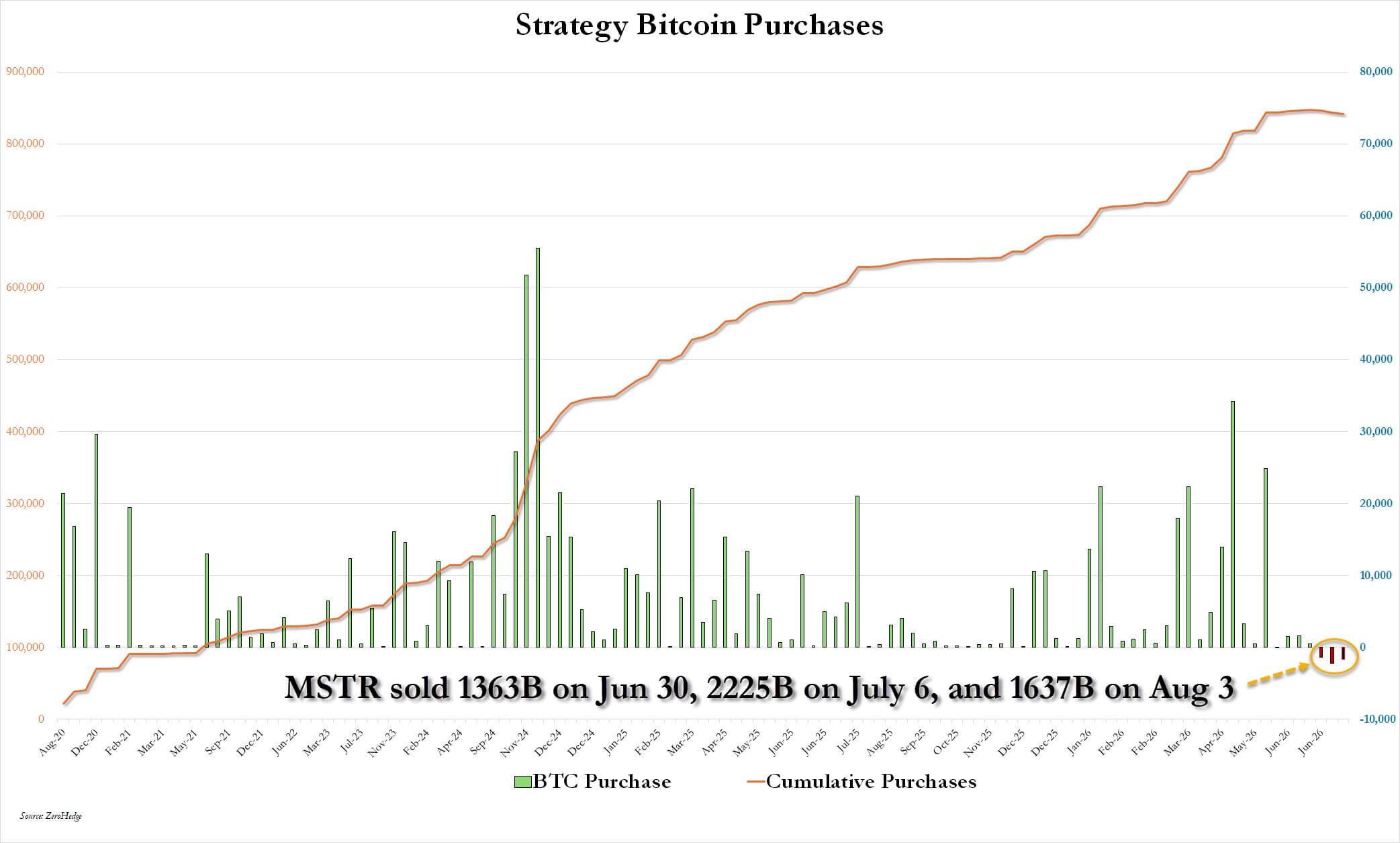
Indeed, the company sold 32 BTC in late May, 1,363 BTC on June 29 and 30, 2,225 BTC during the first five days of July, and another 1,638 BTC last week.
Bitcoin analyst Will Clemente said these transactions provided greater clarity about how Strategy intends to balance the interests of Bitcoin holders, MSTR shareholders and preferred investors.
The sales showed that management was prepared to move capital across its balance sheet rather than allow pressure in one security to weaken the wider financing structure, he said.
Strategy formalized that flexibility through its BTC Monetization Program. The framework authorizes the company to sell Bitcoin to increase its dollar reserve by as much as $1.25 billion, pay preferred dividends and debt interest, and finance repurchases of preferred or common shares.
Sales outside those purposes or beyond the approved limits would require additional board authorization.
Executive Chairman Michael Saylor has rejected claims that the program represented a breach of a formal promise to hold every Bitcoin indefinitely.
He said:
“Strategy announced its BTC Monetization Program on June 29, 31 days before our Q2 results, not after posting a loss. We have never had a ‘never sell’ policy. The program does not require any BTC sale, and we expect to remain a net buyer of Bitcoin over time.”
Strategy remains the largest corporate holder of Bitcoin, with 842,138 BTC representing just over 4% of the asset's maximum supply of 21 million coins.
The company acquired those holdings for $63.51 billion at an average price of $75,419. With Bitcoin trading near $62,633 as of press time, the treasury was worth approximately $52.7 billion, placing its market value about $10.8 billion below Strategy's aggregate acquisition cost.
That gap increases the cost of further monetization. Additional sales below the company's average purchase price would crystallize losses while reducing the Bitcoin supporting its expanding structure of common shares, preferred securities and recurring dividend obligations.
Saylor's expectation that Strategy will remain a net buyer therefore depends increasingly on whether restoring STRC to par allows the company to resume raising capital without continuing to dilute MSTR shareholders or draw down its Bitcoin treasury.
The post Strategy sells $395 million in Bitcoin and MSTR stock to buyback $81 million in STRC and build cash reserve to $4 billion appeared first on CryptoSlate.