

XRP’s latest decline is exposing a widening split between traders betting on more weakness and investors using the selloff to build exposure.
Over the past few weeks, the digital asset has faced sustained downward pressure driven by capitulating short-term holders and aggressive short selling in futures markets.
However, underlying spot demand has proved resilient, as evidenced by XRP-linked exchange-traded funds being on track to record their strongest monthly performance of the year.
This market disconnect is playing out as Ripple accelerates its expansion into institutional finance, providing long-term investors with a structural adoption narrative even as momentum traders exit at a loss.
For market participants, the critical question is whether XRP is establishing a macro accumulation base or simply pausing within an extended downtrend.
Trader losses mount as sentiment sours
Beneath XRP’s sluggish price action lies significant retail distress. According to blockchain analytics firm Santiment, the average trader active in the token over the past 30 days is holding unrealized losses of roughly 47%.
The drawdown has pushed XRP’s 30-day market-value-to-realized-value (MVRV) ratio to its lowest point since December 2020.
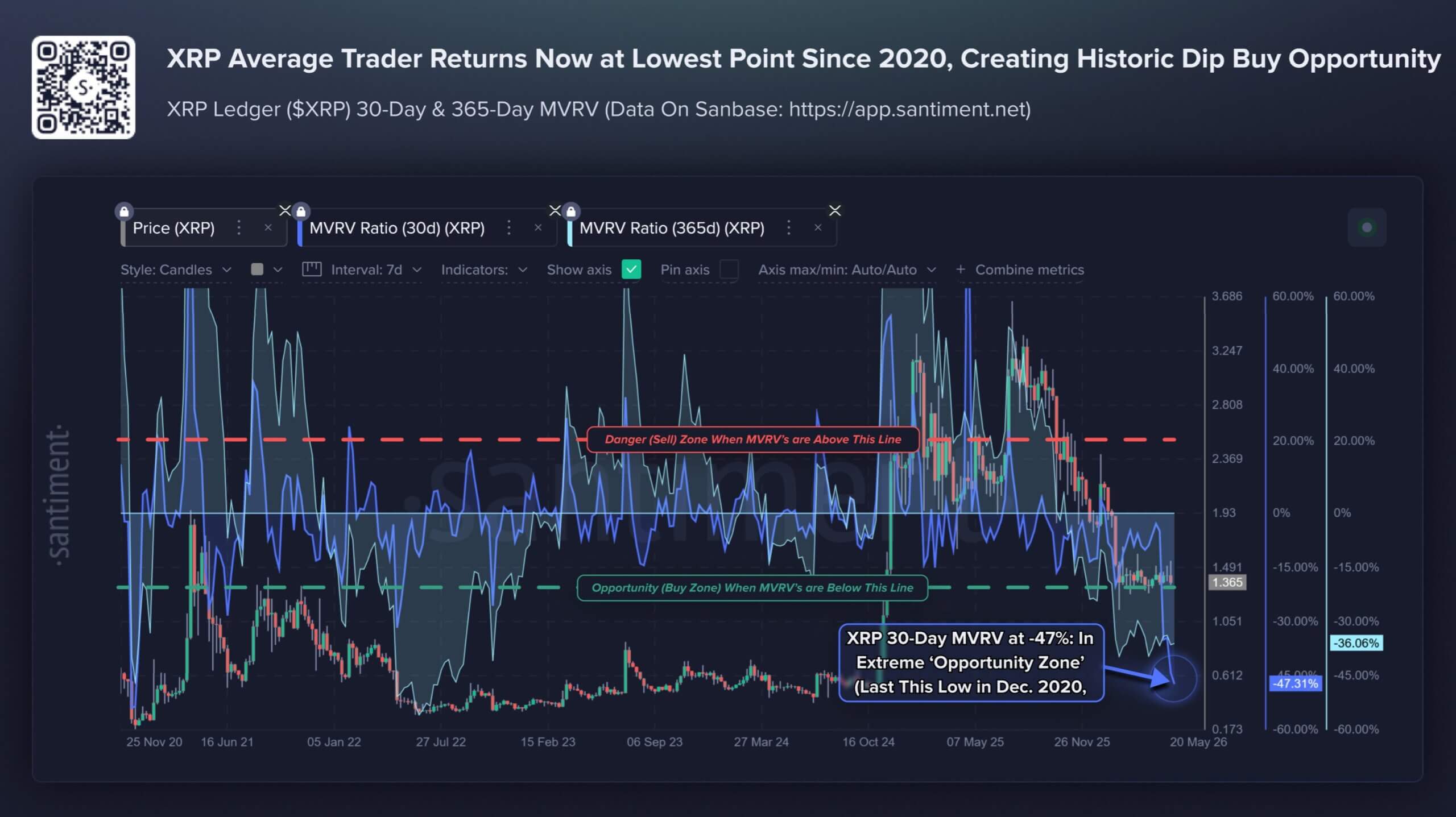
The steep decline marks a sharp reversal from recent optimism. XRP surged in late 2024 and early 2025 as investors priced in favorable regulatory developments, the debut of US exchange-traded funds, and Ripple’s evolving corporate profile.
The subsequent pullback trapped many late entrants, leaving them underwater after acquiring the asset near local peaks.
In cryptocurrency markets, deeply negative MVRV readings often serve as a gauge of trader exhaustion rather than a direct directional signal.
When a large segment of the short-term holder base is severely compromised, the risk of forced selling typically diminishes. For XRP proponents, this zone suggests that months of liquidations may be nearing an end.
Moreover, the broader crowd sentiment surrounding the token aligns with this exhaustion.
Santiment’s positive-to-negative commentary ratio for XRP has compressed to approximately 1.1 bullish remarks for every bearish one, indicating that the speculative fervor defining earlier rallies has largely evaporated.
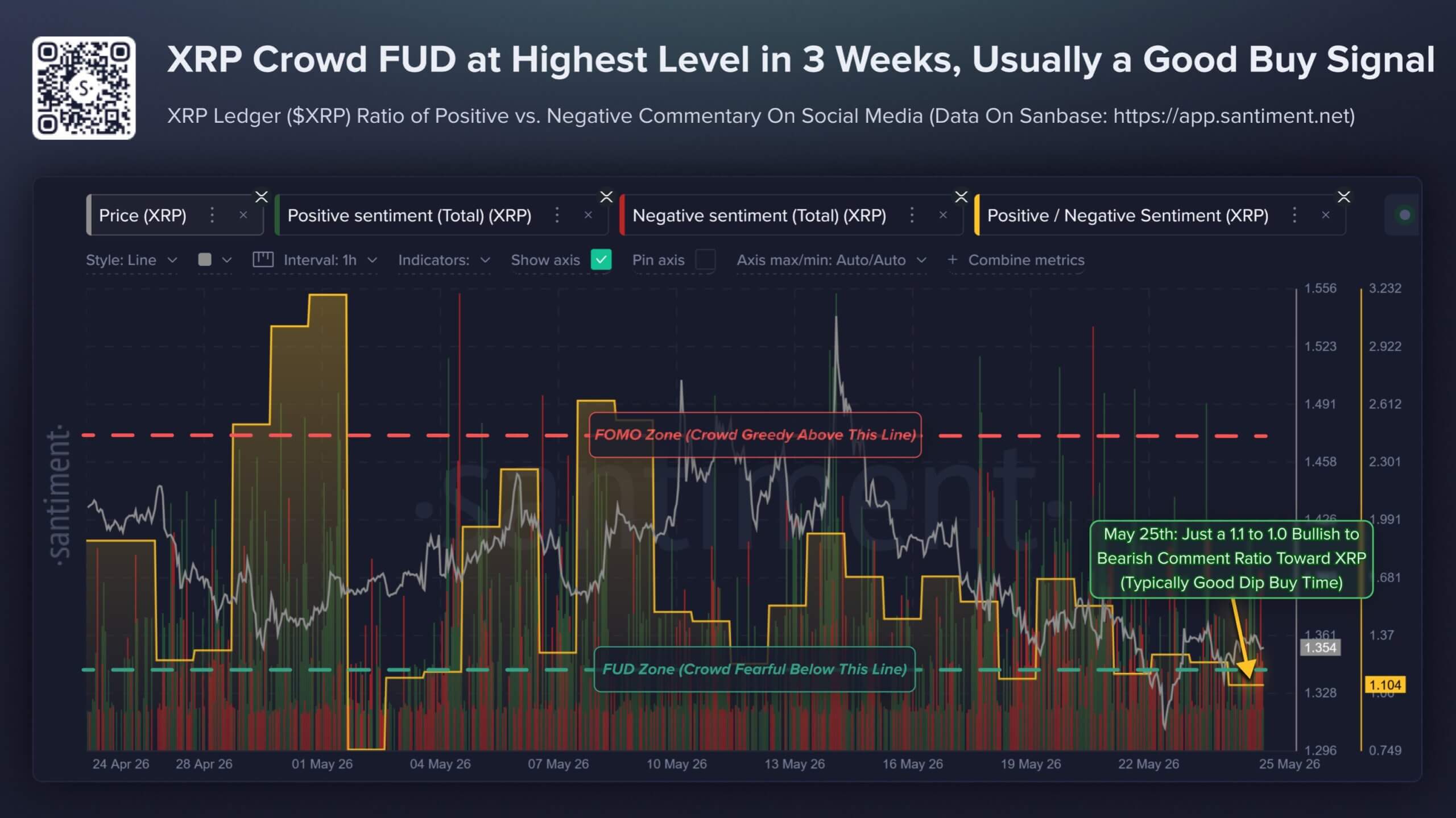
While extreme pessimism can serve as a contrarian indicator, signaling that weak hands have exited the market, sentiment alone is insufficient to catalyze a reversal.
Thus, XRP requires clear evidence of buyer conviction that can absorb the heavy selling pressure originating from leveraged trading platforms.
Derivatives selling meets spot market absorption
The structural divide between retail capitulation and institutional accumulation is most visible across exchange order books.
Data compiled by CryptoQuant shows a sharp bifurcation between XRP’s spot and derivatives venues.
On May 22, open interest for XRP expanded aggressively across centralized derivatives exchanges. Binance recorded an addition of roughly 25.6 million XRP in open interest, while Bybit added 54 million XRP.
The combined injection of nearly 79.6 million XRP carried a notional value of approximately $107 million, with the asset trading near $1.35.
A subsequent surge occurred on May 26, when Binance open interest increased by another 28.9 million XRP, paired with a 42.9 million XRP rise on Bybit. At an average price of $1.34, this represented $96 million in new speculative positioning.
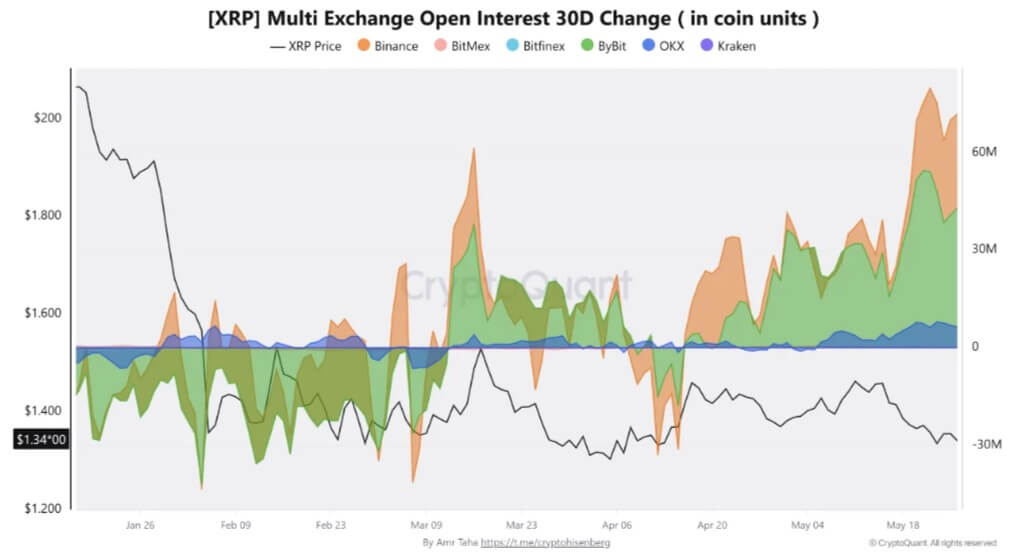
These events marked the most significant expansions in XRP open interest since mid-March, signaling a return of speculative leverage after a two-month lull.
However, the direction of that leverage provides the critical context.
The cumulative volume delta (CVD) for Binance perpetual futures has plunged to a record negative reading of roughly -$641.9 million. This metric indicates that aggressive short sellers have dominated the perpetual market, persistently betting against the token even as open interest climbs.
Conversely, spot markets demonstrate the opposite trend. Estimated spot CVD across all centralized exchanges has increased to roughly $397.3 million, surpassing the $380 million threshold established in late April.
The divergence is stark: traders are heavily utilizing leverage to short XRP, while spot buyers are consistently taking the other side of those trades.
The XRP-linked ETF products corroborate this absorption thesis. Data from SoSoValue shows that the US-listed spot XRP funds are pacing toward their strongest monthly performance this year, drawing approximately $117 million in recent inflows and extending their positive streak to 13 consecutive trading sessions. This has pushed their cumulative inflows beyond $1.12 billion.
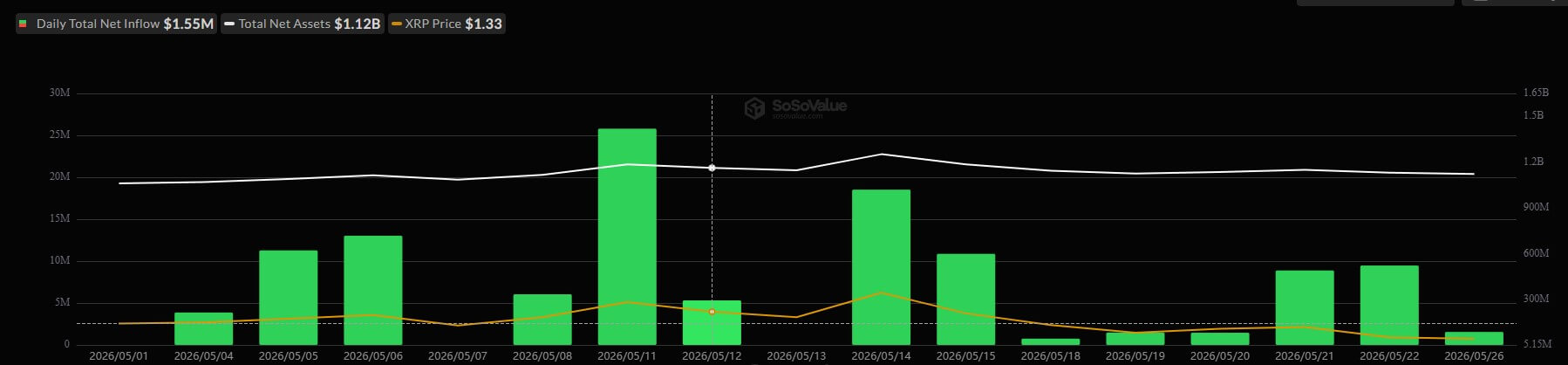
While ETF inflows cannot entirely offset futures market pressure, they provide a regulated anchor for the asset.
The data suggests that XRP’s current price weakness is being met by capital with a longer investment horizon, shifting the market focus toward Ripple’s corporate developments.
Ripple’s Wall Street foray bolsters fundamental case
Ripple’s ongoing strategic pivot has injected a new fundamental narrative into XRP’s market structure.
The company recently filed US trademark applications that reflect a clear ambition to integrate traditional financial operations, covering treasury operations, prime brokerage, hedge fund management, securities lending, financial clearinghouse services, and digital asset management.
While trademark filings do not guarantee the launch of specific products, they delineate a company’s strategic perimeter. In this instance, the filings indicate a calculated push into the core infrastructure of institutional finance.
This direction aligns with the firm's ongoing aggressive corporate buildout that began last year.
During this period, Ripple has structured a vertically integrated enterprise comprising Ripple Prime, which serves as an institutional trading desk; Ripple Custody, which secures assets via institutional-grade architecture; and Ripple Payments, which functions as a cross-border settlement layer.
XRP and the RLUSD stablecoin operate as the connective tissue, facilitating liquidity and treasury workflows across these divisions.
Market observers noted that Ripple is positioning itself as a crypto-native alternative to legacy clearinghouses and investment banks by expanding beyond its original mandate of cross-border remittances.
This evolution provides long-term XRP holders with an adoption thesis that is decoupled from retail trading enthusiasm.
What's next for XRP?
As Ripple constructs its institutional framework, on-chain data is prompting debate over the XRP Ledger’s (XRPL) macro trajectory.
Additional data from CryptoQuant highlight massive, anomalous spikes in XRPL transaction counts. Historically, these vertical surges in network activity have served as leading indicators, occurring months before significant price expansions.
In November 2019, an extreme spike in trading volume preceded XRP’s 2021 bull run, which saw the token appreciate from roughly 15 cents to $1.79. A parallel event occurred in July 2024, acting as a precursor to the asset’s climb from 50 cents to its mid-2025 cycle peak of $3.17.
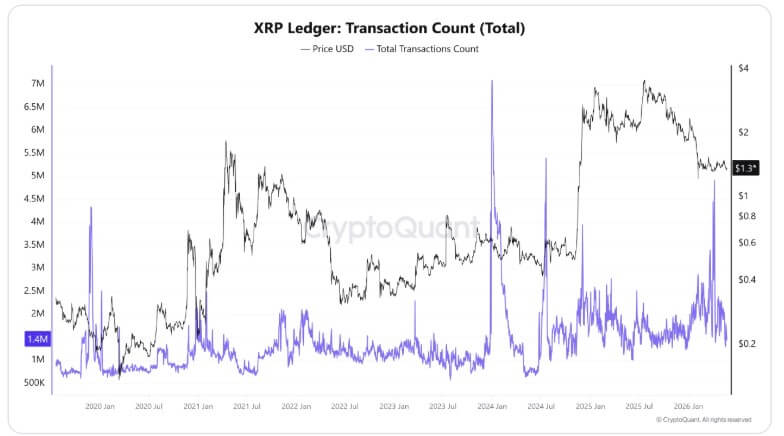
Market analysts are now scrutinizing a similar explosion in transaction volume recorded in April 2026. Following that surge, XRP has entered a prolonged consolidation phase, trading primarily within a $1.30 to $1.50 range.
Proponents of this cyclical theory argue that if historical patterns hold and the current range solidifies into a macro floor, a standard multiple expansion could position XRP’s next cycle target between $7.50 and $8.00.
However, such projections remain speculative cycle comparisons rather than guaranteed forecasts. Previous network spikes did not trigger immediate price appreciation; they were followed by extensive periods of reaccumulation, cooling, and structural market realignment.
For XRP to mount a sustained rally toward those targets, the market would need to exhibit continued spot absorption, a capitulation of short sellers in the derivatives market, and a definitive technical breakout.
Presently, the market remains in a state of friction. Retail traders are absorbing heavy losses, sentiment is deeply depressed, and futures speculators are aggressively shorting the asset.
Yet, strengthening spot cumulative volume delta, consistent ETF inflows, and Ripple’s steady encroachment into Wall Street infrastructure suggest a robust counter-narrative.
If spot demand continues to neutralize derivatives selling, the current period of extreme pessimism may ultimately be recognized as a foundational accumulation phase.
Until that underlying demand is either exhausted or victorious, Ripple’s institutional expansion remains a forward-looking catalyst anchored to a market waiting for its next decisive move.
The post Ripple is expanding institutional finance ambitions while XRP traders are losing confidence appeared first on CryptoSlate.