
Congress is moving crypto’s next adoption fight into the tax code, where legal rails and everyday usability can split apart.
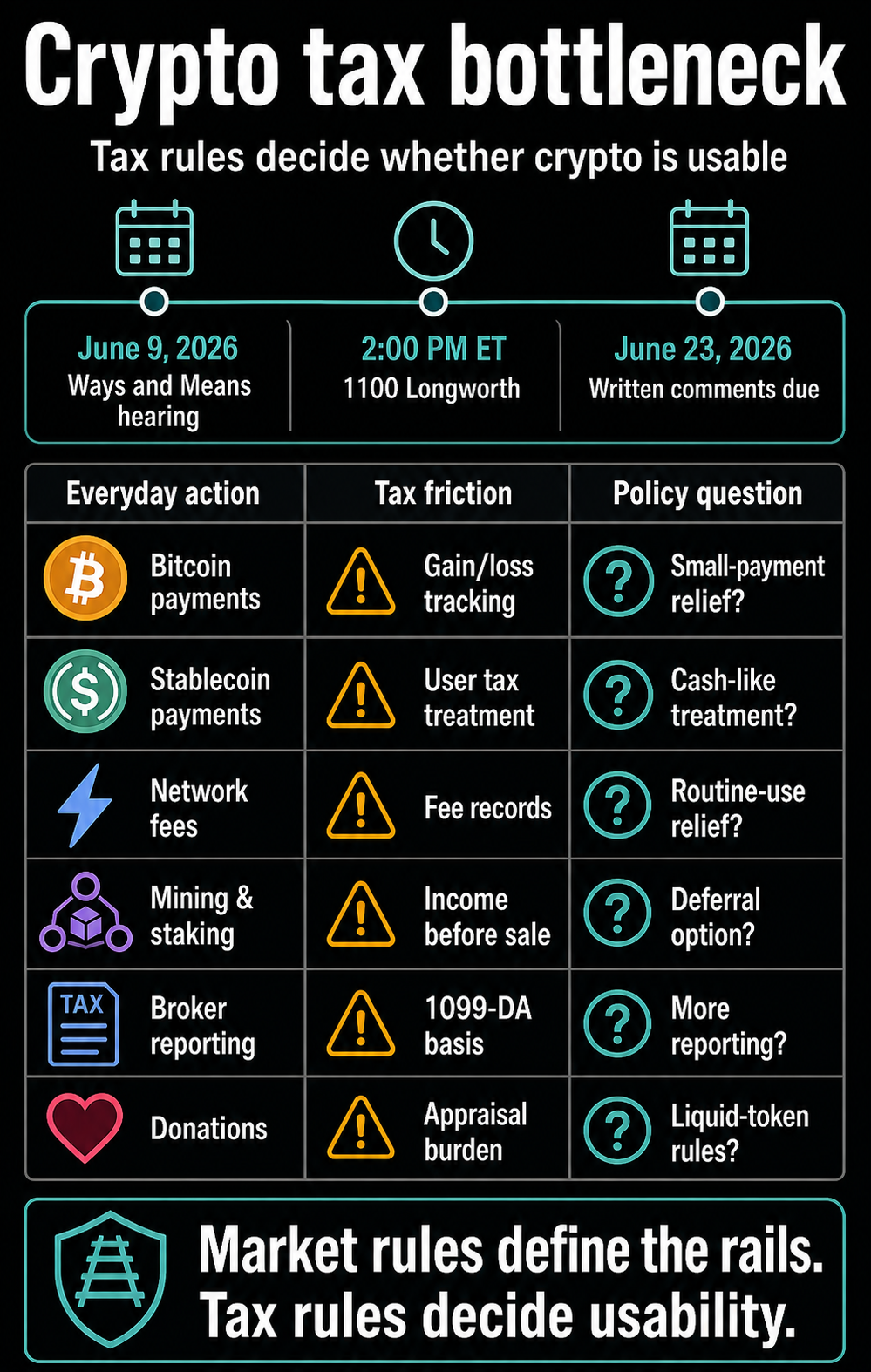
The House Ways and Means Committee is scheduled to hold a June 9 legislative hearing on digital asset taxation at 2:00 PM ET in 1100 Longworth. The witness list includes Sarah Reilly of Fidelity Investments, Lawrence Zlatkin of Coinbase, Jason Somensatto of Coin Center, and Mike Kaercher of the Tax Law Center at NYU Law.
The committee also set a June 23 deadline for written comments, giving tax writers two weeks after the hearing to build the record.
The hearing puts tax rules on the same policy track as market structure and payment stablecoins. The GENIUS Act created a federal payment-stablecoin framework, while the CLARITY Act passed the House and remains part of the market-structure debate.
Market rules can define legal rails. Tax law decides whether a user who buys something with Bitcoin, moves funds on-chain, pays a network fee, earns staking rewards, mines a block, or donates digital assets can avoid a separate calculation.
The question before tax writers is practical: if crypto is meant to function as payments and settlement infrastructure, should every small on-chain action remain a taxable event or recordkeeping task?
The payment problem is a tax problem
The current baseline starts with the IRS view that convertible virtual currency is property for federal tax purposes, meaning general property-transaction rules apply.
That frame turns a payment into more than a payment. A user may need to know basis, fair market value, and gain or loss at the time of spending instead of recording that dollars changed hands.
Taxpayers see that friction in the IRS digital assets overview, which says people should answer yes to the digital asset question if they disposed of digital assets for goods or services in any amount, exchanged one digital asset for another, or paid a transfer fee with digital assets.
The same overview says digital asset transactions must be reported whether or not they result in taxable gain or loss.
For a long-term investor, those rules may look like ordinary capital-asset accounting. For a payment user, they are a design constraint.
A small Bitcoin transaction can require the same conceptual machinery as a sale of an investment. A network fee paid in crypto can matter even when the user is moving assets between wallets the user owns or controls.
Lawmakers already have a neutral map of that problem. The Joint Committee on Taxation’s 2025 digital asset report said no digital asset is treated as currency for federal income tax purposes and that no general de minimis rule excludes gains on small personal transactions.
It also noted the asymmetry for personal use: gains can be recognized, while losses generally are not allowed outside business or income-production settings.
That is the core adoption bottleneck. A market can have clear trading venues, regulated issuers, and better broker reporting while still leaving routine payment behavior too burdensome for normal use.
Stablecoins may receive special treatment because Congress already acted on their regulatory status. The GENIUS Act, enacted as Public Law 119-27 in July 2025, created a federal regime for payment stablecoins.
Issuer rules and reserve standards, however, leave user-side tax treatment as a separate question.
Stablecoins may get the first tax break
One live proposal shows how tax writers may try to bridge that gap. The Digital Asset PARITY Act package addresses stablecoin payment treatment, source-of-income rules, lending transactions, wash-sale and constructive-sale rules, mark-to-market elections, mining and staking reward timing, charitable contributions, and a Treasury study on small digital asset transaction relief.
The most direct payment provision concerns regulated dollar stablecoins. Under the PARITY one-pager, qualifying stablecoin spending would be treated like cash for tax purposes when qualification conditions are met.
If enacted, that could make payment stablecoins easier to use in everyday commerce because the user would not have to treat each qualifying stablecoin payment like a mini disposition of property.
Stablecoin-specific relief would answer part of the usability question. It would help digital dollars, but Bitcoin-style payments and other non-stablecoin transfers would still face basis tracking.
That distinction makes the hearing more than a stablecoin follow-up. It is a test of whether Congress wants tax relief to support regulated dollar tokens alone or to address small digital asset activity more broadly.
Sen. Cynthia Lummis has already pushed the broader version of that debate, proposing a $300 de minimis rule with a $5,000 annual cap.
PARITY, by contrast, asks Treasury to study de minimis relief for small digital asset transactions and provide interim guidance. Those approaches imply different policy priorities.
One favors stablecoin payments. The other would make it easier for assets such as Bitcoin to be used in small transactions without constant accounting drag.
| Activity | Tax friction at issue | Policy pressure point |
|---|---|---|
| Bitcoin payments | Property treatment can require gain or loss calculation on spending. | Broader small-transaction relief or a de minimis rule would matter most. |
| Stablecoin payments | Regulatory approval leaves user-side tax treatment as a separate question. | PARITY would treat qualifying regulated dollar stablecoin payments like cash. |
| Network fees | Fees paid with digital assets can create reportable tax records. | Lawmakers must decide how routine on-chain movement should be treated. |
| Mining and staking | Rewards can create income before sale or cash realization. | PARITY proposes a deferral election for up to five taxable years. |
| Lending and trading | Tax rules must distinguish ordinary financing from disguised sales or abuse. | PARITY pairs lending treatment with wash-sale and constructive-sale provisions. |
| Donations | Noncash property rules can add valuation and appraisal burdens. | PARITY proposes different treatment for liquid assets and less liquid tokens. |
Fees, mining and staking expose the same design choice
Network fees bring the same tax friction to blockchain infrastructure. On-chain fees are the cost of using the network, yet paying them with a digital asset can create reportable records even when the user is only settling or moving assets outside a commercial purchase.
Mining and staking create a different version of the mismatch. IRS guidance and JCT materials describe rewards as taxable when received under current rules, while the PARITY materials frame that treatment as a cash-flow problem for network participants who may owe tax before selling the asset.
The proposed answer is an election to defer income recognition for up to five taxable years until disposition.
For proof-of-work miners and proof-of-stake validators, that timing is operationally important. They secure networks and receive digital assets as rewards.
Taxing those rewards at receipt can force a valuation and liability before there is cash to pay it. Deferral would preserve taxation while moving the timing closer to a sale or other disposition.
Broker reporting is another part of the same shift. For 2026 and beyond, the IRS Form 1099-DA instructions require digital asset brokers to report gross proceeds for sales after 2025 and include basis reporting for covered securities.

They also provide optional reporting methods for stablecoins and NFTs and add wash-sale fields for tokenized securities. The instructions address rewards and staking payments through an exception rather than by making those payments reportable on Form 1099-DA.
Those rules leave user-side tax questions in place, but they show the tax system becoming more explicit about digital asset activity. Reporting infrastructure, anti-abuse rules, and adoption relief are now being built at the same time.
The hearing will show how lawmakers try to distinguish ordinary network use from transactions that should be treated like investment sales or tax-avoidance trades.
The hearing turns market structure into a usability test
The witness list reflects that broader terrain. Fidelity and Coinbase bring market and platform perspectives. Coin Center brings a policy-advocacy view. The Tax Law Center at NYU Law brings a tax-law lens.
Together, they put the committee in position to ask what rules would help the industry, which rules are administrable for the IRS, and what treatment is fair to taxpayers.
The June 23 comment deadline is the next meaningful signal after the hearing. Written submissions may show whether commenters converge around stablecoin-specific treatment, a de minimis rule for small digital asset transactions, mining and staking timing relief, or stricter reporting and anti-abuse provisions.
CLARITY belongs in the background. Its House passage showed bipartisan appetite for defining market oversight, and its Senate status still matters for exchanges, brokers, issuers, and regulators.
The tax hearing asks a different question. Even if market structure becomes clearer, crypto’s everyday usefulness depends on whether tax rules let people transact without treating every payment, fee, and reward like a tax-lot exercise.
The outcome could shape which form of crypto adoption Congress is willing to encourage. Stablecoin-only relief could steer payments toward regulated digital dollars and leave Bitcoin primarily in an investment or treasury role for many users.
Broader relief for small digital asset transactions would signal a larger ambition: crypto as usable payment technology alongside its role as a regulated asset class.
The June 9 hearing is a policy bottleneck in its own right. The law can tell companies where to register and tell stablecoin issuers how to operate, but tax rules decide whether a person can actually use a digital asset without opening a spreadsheet.
Until Congress answers that question, spending crypto remains less like tapping a card and more like selling a tiny piece of property each time.
The post Congress is weighing whether crypto tax relief should stop at stablecoins appeared first on CryptoSlate.