
Bitmine plans to slow its Ethereum purchases as its holdings approach 5% of the cryptocurrency’s supply, ending a year of rapid accumulation that made the company the network’s largest corporate token holder.
In his July Chairman message, Thomas Lee said Bitmine has amassed 5.7 million ETH, equal to about 4.8% of supply, but will approach the 5% threshold gradually rather than continue buying at its previous pace.
The shift opens a new phase for Bitmine. The company plans to direct more capital toward staking, Ethereum infrastructure, and financial services investments as it seeks to expand the network’s economic use and strengthen the value of the tokens already on its balance sheet.
A self-imposed ceiling emerges
Bitmine's decision to stop near 5% reflects the complications that arise when a public company becomes one of the largest owners and staking operators on a proof-of-stake network.
Lee linked the decision partly to changes at the Ethereum Foundation, the nonprofit organization that has long supported the blockchain's development. According to him, discussions with people connected to the foundation persuaded Bitmine to avoid accelerating its purchases during the transition.
Lee said:
“At the moment, I think we shouldn’t try to accelerate and have more concentration beyond 5%.”
The restraint introduces a consideration largely absent from corporate Bitcoin treasury strategies. Ethereum holders can stake their tokens, operate validators and collect rewards for helping secure the network, giving a large treasury an operational role beyond holding the asset as a reserve.
Owning 5% of ETH would not give Bitmine control over Ethereum. Its total holdings also differ from the amount it has committed to staking and the share of validators it operates.
The position nevertheless gives Bitmine substantial staking capacity. The company has pursued that opportunity through MAVAN, its Made in America Validator Network, which Bitmine describes as the world's largest single institutional Ethereum staking platform.
Notably, Bitmine reported $45.7 million in staking and validation revenue for the three months ended May 31, following the launch of native staking last November. The figure included $3.5 million related to its acquisition of the staking operator Pier Two.
The strategy leaves Bitmine heavily exposed to ETH price movements.
Lee said the correlation between the company's shares and Ethereum was about 90%, indicating that investors continue to treat the stock largely as a proxy for the cryptocurrency despite its growing staking and investment operations.
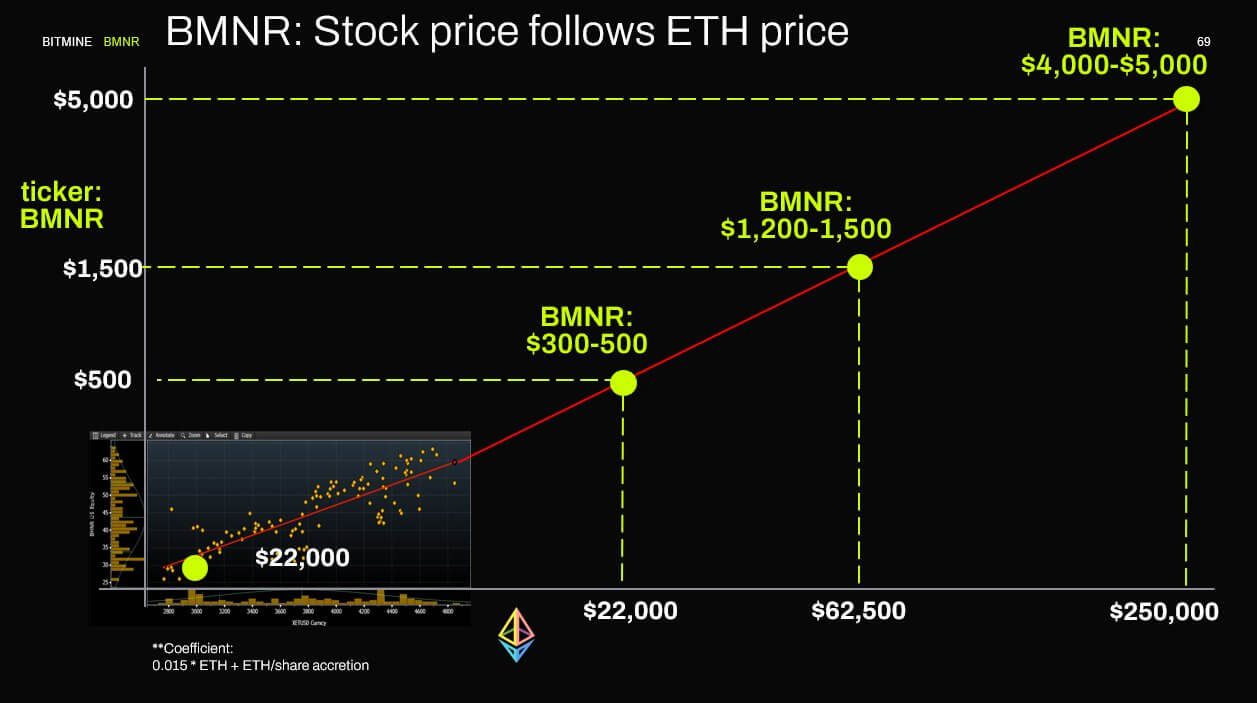
The approaching target therefore creates a strategic challenge. Continuing to accumulate at its earlier pace could heighten concentration concerns, while slowing purchases removes the main mechanism Bitmine previously used to expand its exposure.
The company must now generate more value from the ETH it already owns.
Bitmine extends further into the Ethereum ecosystem
As direct accumulation slows, Bitmine plans to deploy more capital across the Ethereum ecosystem and into businesses that could increase demand for the network.
Lee said the company served as the lead investor in ETH Labs, Ethereum Institutional and ETH Systems. The organizations are working on areas including institutional adoption and confidential infrastructure for companies that want to conduct financial activity on Ethereum.
Bitmine also plans to fund additional Ethereum organizations, commercial partners, and public goods as the Ethereum Foundation reduces its role in some areas.
The strategy directly serves Bitmine’s financial interests. Greater Ethereum adoption could strengthen demand for ETH, increasing the value of its 5.7 million-token reserve and supporting its share price.
Its investments could also give Bitmine a larger role in determining which infrastructure projects and institutional products receive commercial backing.
However, Lee framed that position as neutral because the firm could potentially become permanent capital, since Bitmine does not sell products to the institutions it hopes to attract.
Additionally, the company’s mandate now extends beyond Ethereum-native projects. Lee said Bitmine would also consider investments in crypto and traditional financial services companies that could move securities, payments, funds, and other assets onto blockchain networks.
That marks a broader strategy than its original focus on accumulating ETH and building staking infrastructure. Lee argued that the distinction between crypto companies and conventional financial institutions will become less relevant as both begin using the same settlement systems.
Under that thesis, a brokerage, custodian, or asset manager moving operations onto Ethereum-based rails could contribute to the network’s adoption as directly as a crypto protocol could.
Lee Said:
“We just want to strengthen the Ethereum ecosystem, which in turn helps the price of Bitmine.”
Meanwhile, Bitmine is also developing capital-market products to finance these expansion efforts. The company recently launched a 9.5% perpetual preferred security under the ticker BMNP, which Lee compared with STRC, one of Strategy’s preferred-stock instruments.
BMNP was issued at $80 in June and had risen to about $86 by the time of his presentation. The security gives investors a yield-bearing claim on a company whose balance sheet remains dominated by Ethereum while providing Bitmine with another funding source alongside common-stock issuance and staking income.
The proceeds could support investments across Ethereum infrastructure and financial services, allowing Bitmine to increase its exposure to the ecosystem without buying ETH at its earlier pace.
Bitmine's move to the New York Stock Exchange and its inclusion in the Russell 1000 could also broaden its investor base. Index membership can generate demand from funds that track the benchmark and make the company more relevant to active managers that use it to evaluate performance. The Russell 1000 represents roughly 1,000 of the largest companies in the US equity market.
However, the new capital comes with additional obligations. BMNP's cumulative dividends continue to accrue even during market downturns, as falling ETH prices reduce the value of Bitmine's reserves.
That increases the pressure on Bitmine to convert its staking operations and ecosystem investments into durable returns.
Tokenized finance and AI underpin Lee's most bullish ETH scenario
Bitmine’s wider strategy ultimately rests on Lee's belief that tokenized finance and autonomous AI agents could turn ETH into working capital for institutions and software.
Robinhood Chain offered his clearest example. The Ethereum layer-2 network uses ETH as its native gas token and is designed to support tokenized equities, exchange-traded funds, private assets and other financial instruments. Lee said its transactions ultimately settle on Ethereum’s main network.
Since its launch, the network has enjoyed significant success, with its daily spot decentralized-exchange volume surpassing that of Ethereum in the last 24 hours.
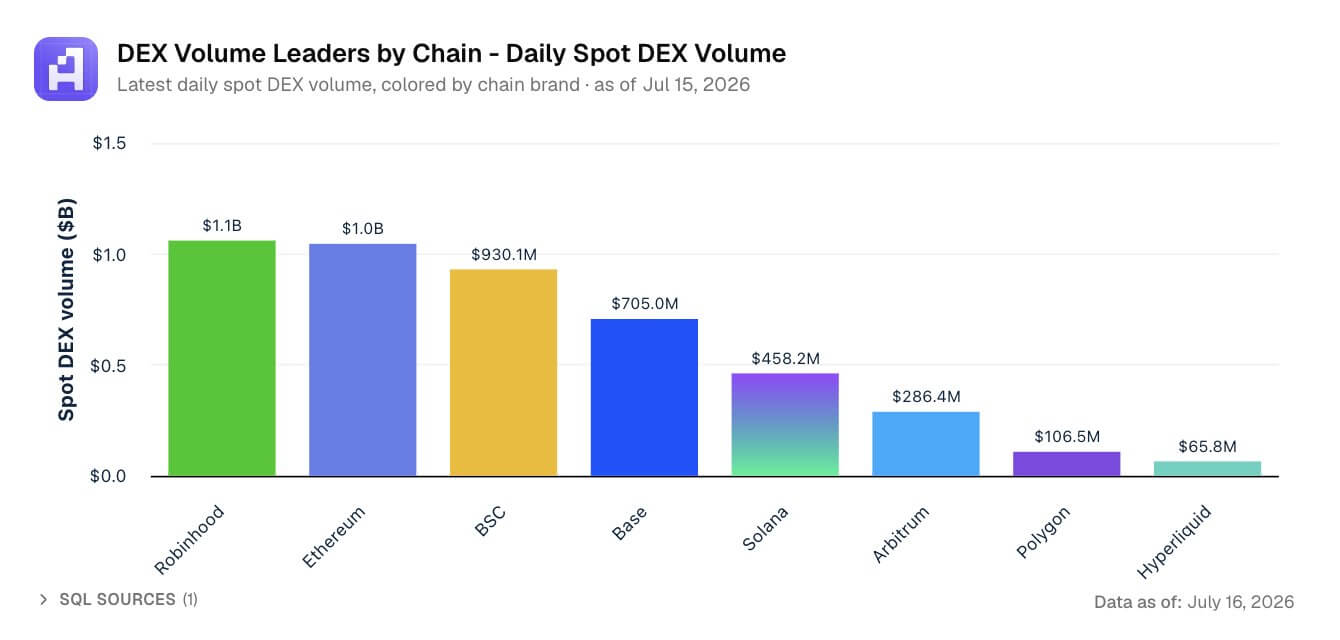
For Lee, that activity shows how brokerages could move stocks, funds and other traditional assets onto blockchain infrastructure while creating recurring demand for ETH.
He also cited tokenization projects involving BlackRock and JPMorgan as evidence that financial institutions are moving toward blockchain-based issuance and settlement.
However, the relationship is not automatic. Layer-2 networks can process substantial activity while paying relatively small fees to Ethereum, while users may transact through stablecoins without holding ETH directly.
Lee’s thesis assumes that institutions will still need meaningful ETH balances as working capital once tokenized markets reach sufficient scale.
Artificial intelligence could add a second source of demand. Lee expects autonomous agents to earn income, execute trades, manage accounts, and purchase services without continuous human direction.
Those agents would need payment networks that operate around the clock and programmable rules limiting how assets can be used.
Smart contracts could provide those controls by restricting an agent’s authority and recording what it owns, spends, or transfers. Ethereum could capture part of that machine economy if agents and their operators need ETH to execute and settle transactions.
Tokenized finance and AI therefore play complementary roles in Lee's argument. Financial institutions could bring large pools of assets onto Ethereum-linked networks, while autonomous agents could create a new population of users conducting transactions at machine speed.
Together, they underpin his description of ETH as “productive money,” an asset held because institutions and software need it to operate, rather than solely because investors expect its price to rise.
That projected demand also supports the most aggressive valuations discussed in the presentation. Lee raised scenarios of $25,000 and $75,000 before citing a $250,000 estimate advanced by Ethereum co-founder Joseph Lubin and Etherealize.
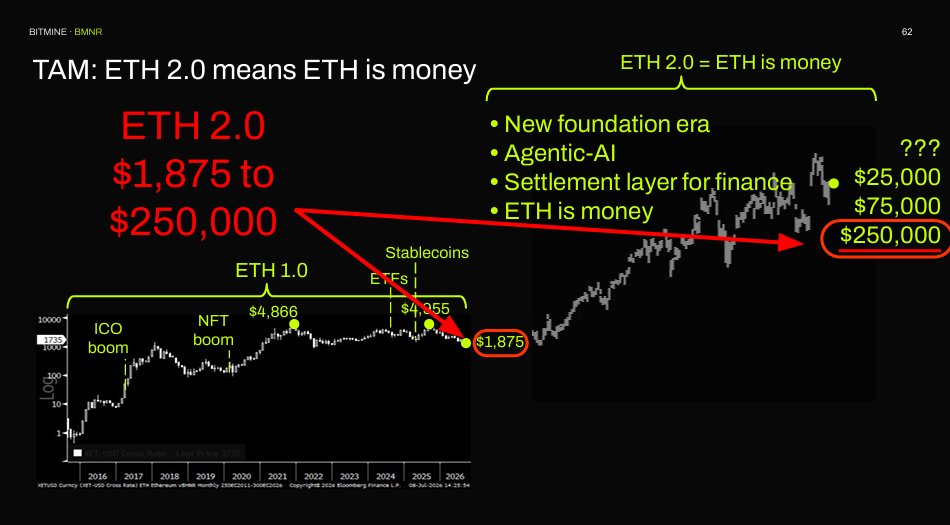
While he stopped short of adopting the highest figure as a formal target, Lee argued that ETH could experience radical upside if Ethereum becomes a major platform for financial settlement and machine commerce.
Reaching that valuation would require Ethereum to capture a significant portion of both markets while competing with rival blockchains, stablecoins, private ledgers and bank-controlled payment systems.
It would also require that increased network use translate into sustained demand for ETH rather than allowing applications to minimize or abstract the token entirely.
The post Bitmine nears its Ethereum buying limit – Now it needs demand to make the bet pay off appeared first on CryptoSlate.