

Wedbush, a multibillion-dollar US investment firm, still rates three of the market’s hottest quantum stocks a buy. Yet there is a catch, because institutional money is quietly leaving them.
Every one of these stocks has corrected sharply this month, down between 24% and 36%. Yet the buy ratings still stand from spring and have not been cut to hold or sell. Meanwhile, the money-flow data tells the opposite story.
IonQ (NYSE: IONQ)
The stock has dropped 36% this month to $34.07, far below its $84.64 high, yet it is still the biggest of the three by market value, near $12.7 billion.

Its business is also growing fast. IonQ reported that first-quarter revenue jumped 755% to $64.7 million, that its order backlog, meaning work sold but not yet delivered, rose 554% to about $470 million, and that it held roughly $3.1 billion in cash. The company also said it sold its first 256-qubit quantum computer to the University of Cambridge.
Even after the drop, analysts have not cut their calls, keeping buy ratings with Rosenblatt near $100, Wedbush at $75, and Northland at $70, though those targets date to May and June.

Dan Ives, the widely followed former-Wedbush analyst whose AI ETF topped $500 million within months of launch, is the loudest voice here. He calls quantum a derivative play on the AI boom, and he even expects the Trump administration to take an equity stake in names like IonQ. However, these drivers are a tad dated. But the new ones surprisingly agree with these.
Note: Wedbush still runs and manages the IVES ETF, despite Daniel Ives’ departure.
IonQ’s put-call ratio, which weighs bearish put bets against bullish call bets, collapsed from 2.69 on July 16 to 0.45 by July 23, so options traders turned sharply bullish.

However, Chaikin Money Flow, a proxy for institutional buying and selling, sat deep in the red near -0.46.

That gap hints at a near-term catalyst that traders expect, while the money flow says larger holders are selling.
One tracked account even flagged IonQ option sentiment above 70 for the first time.
Rigetti Computing (NASDAQ: RGTI)
Rigetti has fallen 24% this month to $14.85, and it leans on government money more than sales.

The company said it secured $100 million from the US Department of Commerce over three years, part of a wider federal package, in return for a small ownership stake. Rigetti also launched a 108-qubit quantum computer, called Cepheus-1, on major cloud platforms.
Even so, coverage stays thin, and the buy ratings near $40 from Rosenblatt and Wedbush simply linger with no downgrade after the drop.

The same split appears again. Rigetti’s put-call ratio fell from 1.09 on July 16 to 0.48 on July 23, a clear bullish tilt in options.

However, its Chaikin Money Flow also stayed negative near -0.24, so the outflows contradict the optimism on the screen.

This pattern again shows that the institutional investors aren’t currently banking on the quantum stocks.
D-Wave Quantum (NYSE: QBTS)
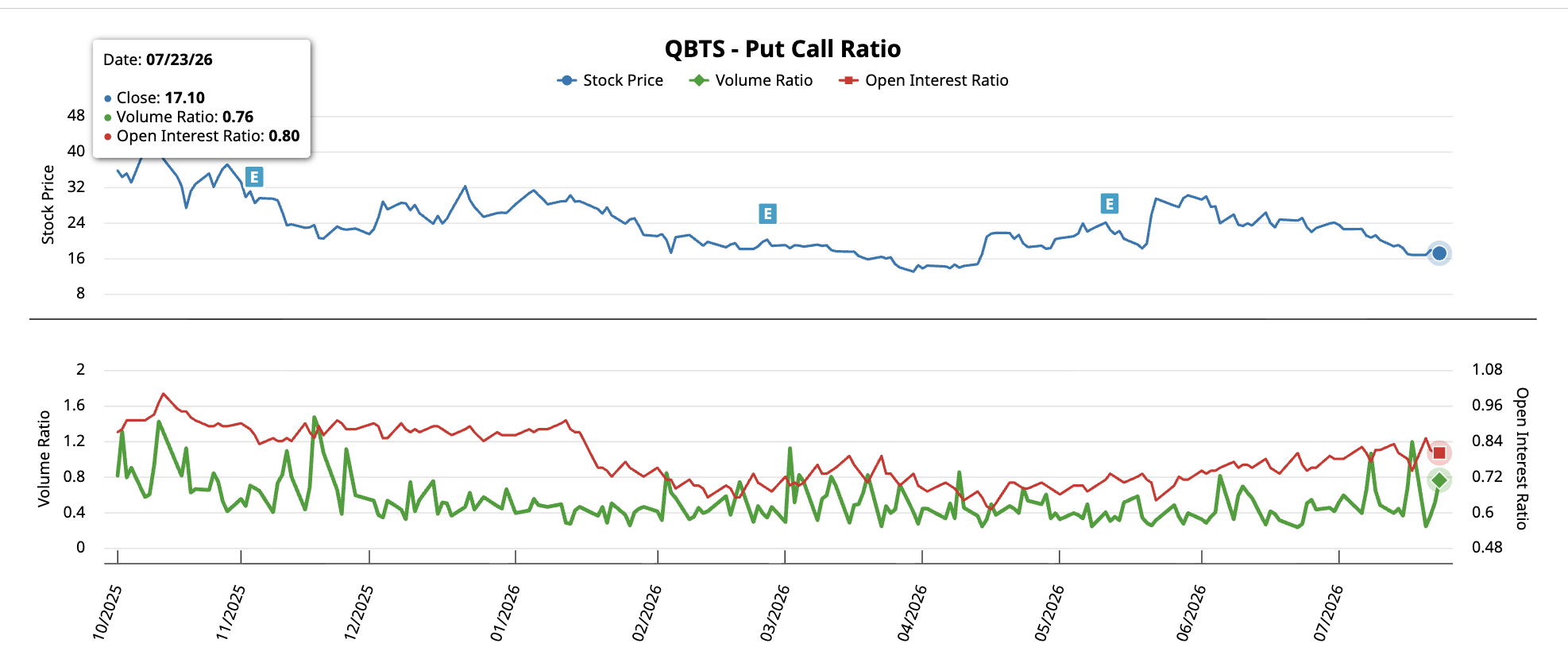
The company stock has fallen 26% this month to $17.10, yet it already makes money from paying customers.

The company reported revenue from more than 100 customers in the first quarter, most of them businesses, with new orders up about 2,000% to $33.4 million even as revenue fell 81% to $2.9 million. Its machines are built for optimization problems like scheduling, not code-breaking. This shows that the current wave of interest around quantum stocks isn’t about breaking Bitcoin.
Here the push and pull is easiest to read. Ten analysts keep buy ratings up to $43 (no hold or sell), but Barchart’s own technical model flashes a 72% Strong Sell. Wedbush again appears on the list.


That bearish call matches the flows. D-Wave’s Chaikin Money Flow sits negative near -0.24, and its put-call ratio eased only from 1.19 on July 17 to 0.76 on July 23, the weakest bullish shift of the three.

So its old buy ratings look the most stretched.
Part of the bull case is that the science keeps advancing. Google Research said last week that it improved quantum error correction 3.5 times, a step toward quantum machines that work reliably.
Even so, the same doubt sits under all three names. Insiders have sold about $988 million of stock since 2021, with almost no buying, even as retail options turn bullish.
So the buy ratings and bullish options pull one way, while selling by insiders and institutions pulls the other. Whether these quantum stocks keep their gains likely depends on real earnings arriving before that patience runs out.
The post Wall Street Still Loves These 3 Quantum Stocks, But The Data Says Otherwise appeared first on BeInCrypto.