

Spot Bitcoin ETFs just had their best day of 2026. Ten of the eleven original funds saw inflows on March 5. Together, they pulled in roughly $500 million. After six weeks of outflows that drained roughly $4.5 billion, the tide has turned — but the hole is not fully closed yet.
Bitcoin is up roughly 12% since US and Israeli forces struck Iran on February 28. Gold initially spiked, then gave back its gains. That gap has reignited a familiar debate about which asset is the real safe haven — and a prominent analyst moved quickly to complicate the answer.
ETF Flows Stage a Comeback
US spot Bitcoin ETFs had their worst start to a year on record in 2026. Six consecutive weeks of outflows — the longest streak since early 2025 — drained roughly $4.5 billion from the funds. BlackRock’s IBIT alone shed over $2.1 billion during the worst five-week stretch. Fidelity’s FBTC lost more than $954 million.
The reversal has been just as sharp. The week of Feb 27 brought $787 million in net inflows. The week of Mar 4 added another $1.15 billion. Bloomberg Senior ETF Analyst Eric Balchunas said the year-to-date hole is now “almost closed.” Cumulative net inflows across all spot Bitcoin ETFs stood at $55.95 billion as of Mar 4 — down from $57.08 billion at the start of the year, but recovering fast.
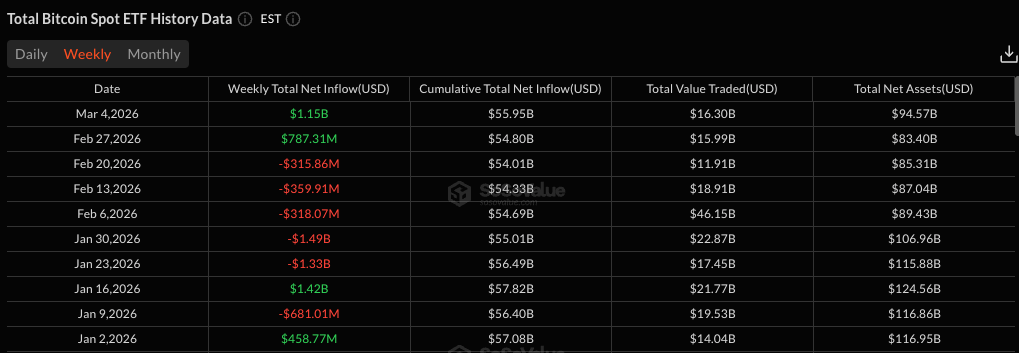
The breadth of participation underlines the shift. Earlier in 2026, inflows were often concentrated in IBIT alone while other funds bled. Ten funds moving in the same direction on March 5 signals a genuine change in sentiment, not just rotation within the ETF complex.
Don’t Read Too Much Into It
Balchunas raised the obvious question on X. Does Bitcoin up 12% mean it is the new safe haven? Does gold falling mean it has lost its purpose? Then he answered it himself: no.
He said he was pointing out a trap. Judging an asset based on a short window of price moves leads to bad conclusions. Bitcoin’s gains, he suggested, may have little to do with geopolitics. A shift in market sentiment and fading institutional headwinds are more likely to be the drivers. Gold’s pullback may simply be profit-taking. “Wth knows,” he wrote.
The actual price action supports his caution. When the Iran strikes hit, Bitcoin dropped sharply — from around $67,000 to as low as $63,038. Gold surged to near $5,376 per ounce. Bitcoin only reversed after news of Khamenei’s death broke. Gold then pulled back as traders priced in possible Fed rate hikes.
Context matters for both assets. Gold had already risen more than $1,000 per ounce in the 60 days before the strikes. Bitcoin had fallen nearly 23% since January — its worst annual opening on record. Both were moving from extreme starting points.
A few days of divergence prove nothing. What the ETF data does show is that institutions are returning to Bitcoin. “Gold has my respect as asset as does bitcoin,” Balchunas wrote.
The post Bitcoin ETFs Reverse 2026 Outflow Streak: Geopolitics Question Remains appeared first on BeInCrypto.